


What Makes a Great Hospital Website? Design Strategies That Drive Patient Conversions
April 24, 2026
SEO for Automotive Industry Simple Guide to Boost Visibility
May 5, 2026What Makes a Great Hospital Website? Design Strategies That Drive Patient Conversions
April 24, 2026SEO for Automotive Industry Simple Guide to Boost Visibility
May 5, 2026SaaS Branding: Why Identity is Your Secret Weapon for User Trust
May 1, 2026
- 15 min to Read
Quick Read
- SaaS branding is not just a logo. It is the entire emotional and strategic identity that earns user trust before the product does.
- The top elements of a successful SaaS brand identity include positioning, voice, visual consistency, UX alignment, and a clear messaging framework.
- Building a SaaS brand takes six focused steps: from brand workshops to launch and continuous monitoring.
- Authenticity and consistency across every touchpoint are what separate brands that scale from those that stall.
Introduction
Most SaaS companies spend enormous resources building product features. They obsess over onboarding flows, fix bugs in real time, and A/B test their pricing pages. And yet, they ignore the one thing users actually evaluate before they ever sign up: brand identity. In a market where switching costs are low and alternatives are always a Google search away, SaaS branding is what makes a user choose you, stay with you, and advocate for you.
Brand identity is not decorative. It is functional. It sets expectations, communicates competence, and creates the psychological safety users need before they hand over their data, their time, or their money. When users cannot physically touch your product before they buy, your brand is the product.
This blog breaks down what it takes to build a SaaS brand that does not just look good, but genuinely earns trust, drives retention, and scales with your growth.
What is SaaS Branding?
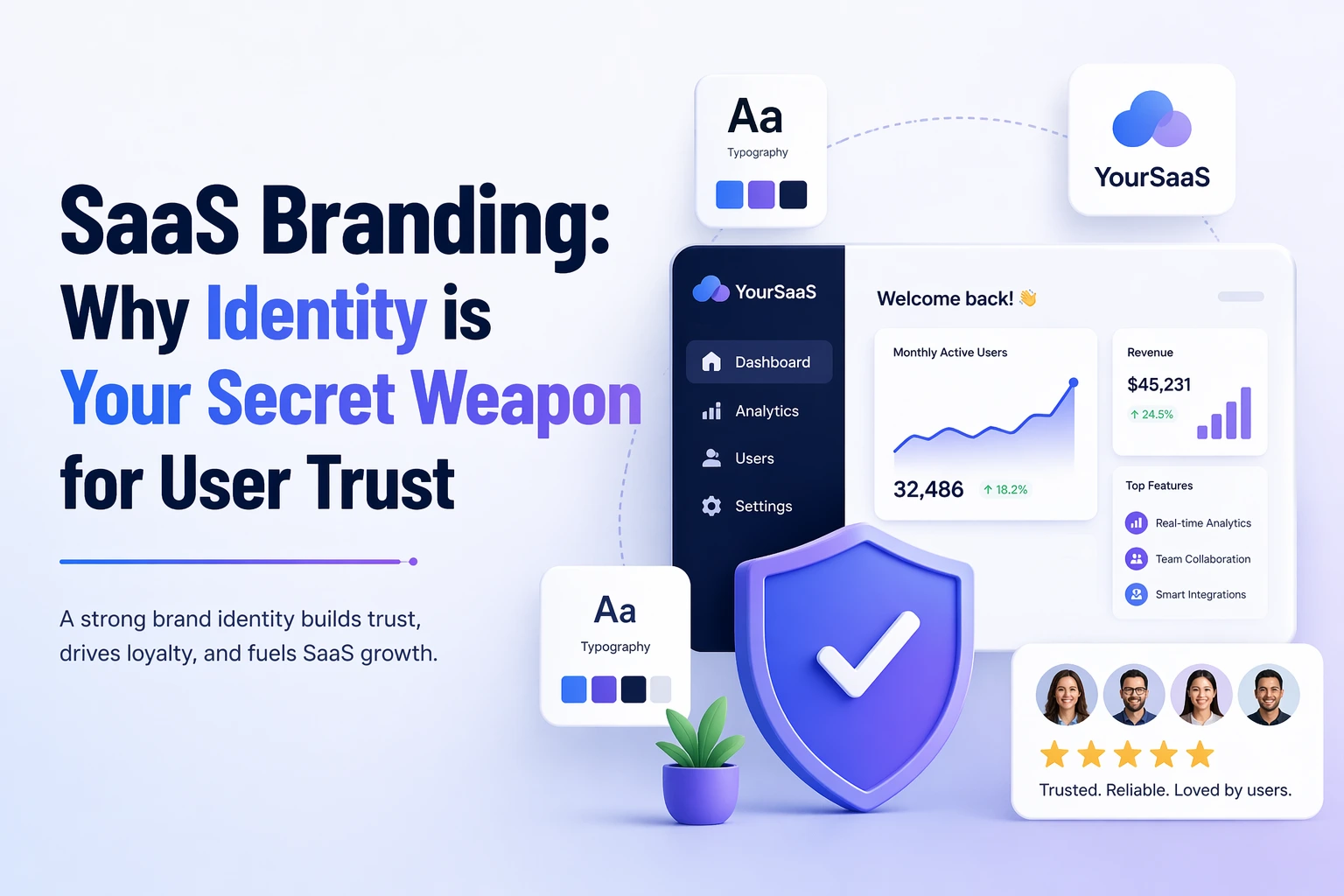
SaaS branding is the strategic and creative process of shaping how your software company is perceived. It covers everything from your company name, logo, and color palette to your messaging, tone of voice, and the emotional experience your product creates at every touchpoint.
It is different from traditional branding because the product itself is the brand experience. Every tooltip, error message, dashboard layout, and customer support interaction reinforces or erodes the brand identity you have built. Unlike consumer goods, a SaaS brand is not just seen. It is used.
A strong SaaS brand communicates three things instantly: what the product does, who it is for, and why it is better than the alternatives. Without that clarity, even the most technically advanced product struggles to gain traction.
The saas brand you build today determines the pipeline you fill tomorrow. It shapes how investors see your company, how employees talk about their work, and how prospects decide whether to book a demo. In short, it is the connective tissue between your product and your market.
Why Brand Identity is Crucial for SaaS Companies
SaaS buyers are skeptical by default. They have been burned by tools that over-promised and under-delivered. They read G2 reviews, ask peers in Slack communities, and compare competitors side-by-side. In that environment, brand identity is one of the only things that can tip the scales in your favor before a single sales call.
Trust is the primary currency in SaaS. And trust is built through consistency. When your website, product UI, emails, social content, and sales materials all feel cohesive, users subconsciously register that you know what you are doing. Inconsistency, on the other hand, signals disorganization, which makes users hesitate.
There is also the competitive reality. In most SaaS verticals, the core features of competing products are nearly identical. The brands that win are not always the most feature-rich. They are the most recognized, the most trusted, and the most emotionally aligned with their target users.
Research from McKinsey consistently shows that strong B2B brands generate significantly higher returns than weak ones. For SaaS specifically, brand trust reduces churn, improves net revenue retention, and shortens sales cycles. These are not soft metrics. They directly impact your bottom line.
Key Elements of a Successful SaaS Brand Identity
Understanding the top elements of successful SaaS brand identity is not just useful for designers or marketers. It is critical for founders, product leaders, and growth teams. Here is what each layer looks like in practice.
Brand Positioning and Strategy
Brand positioning for SaaS is the strategic decision about where your product sits in the minds of your target customers relative to competitors. It answers: "Why should a specific type of user choose us, and not the next option?"
Positioning is not your tagline. It is the thinking behind it. It defines the category you play in, the audience you serve, and the unique value you deliver. Weak positioning leads to generic messaging, which leads to poor conversion rates regardless of how good your product is.
Brand Voice and Tone
Your saas brand voice is how your company sounds across every piece of content. Is it confident or cautious? Warm or clinical? Playful or precise? Voice should stay consistent while tone adapts to context. You may be conversational in a blog post and more formal in a security white paper, but the underlying character stays the same.
Companies that nail their voice stand out immediately. Think of how Notion feels approachable without being unprofessional, or how Linear feels sharp and uncompromising without being cold. Voice is often the first thing users notice and the last thing they remember.
Visual Identity: Logo, Typography, and Color Palettes
Visual identity is the most visible layer of your brand. But its purpose is not aesthetics. Every visual decision sends a signal. A clean, geometric logo communicates precision. A warm color palette communicates approachability. Typography affects how readable and credible your product feels.
For SaaS companies, visual identity also extends into the product itself. The icons, button styles, data visualizations, and empty states inside your dashboard are all branding decisions. They shape how users feel while they work.
Product UX/UI Consistency
Your marketing site can be beautiful, but if the product UI feels like it was built by a different team, the brand falls apart. Consistent design patterns, familiar interaction models, and predictable navigation all reduce cognitive load. They make users feel confident, not confused. This is where saas brand marketing and product design must work in lockstep, not in silos.
Developing a Messaging Framework
A messaging framework documents the words your company uses to talk about itself: the core value proposition, persona-specific benefits, proof points, and objection-handling language. Without it, sales, marketing, and product all talk about the product differently, which creates friction and confusion for buyers. A great messaging framework is short, specific, and immediately usable.
Ready to refresh your brand?
Contact Upclues today and start your branding journey.
How to Build a SaaS Brand: A Step-by-Step Guide
Knowing how to build a saas brand is one thing. Doing it with intention, speed, and cross-functional alignment is another. Here is a process that works for both early-stage startups and growth-stage companies undergoing a rebrand.
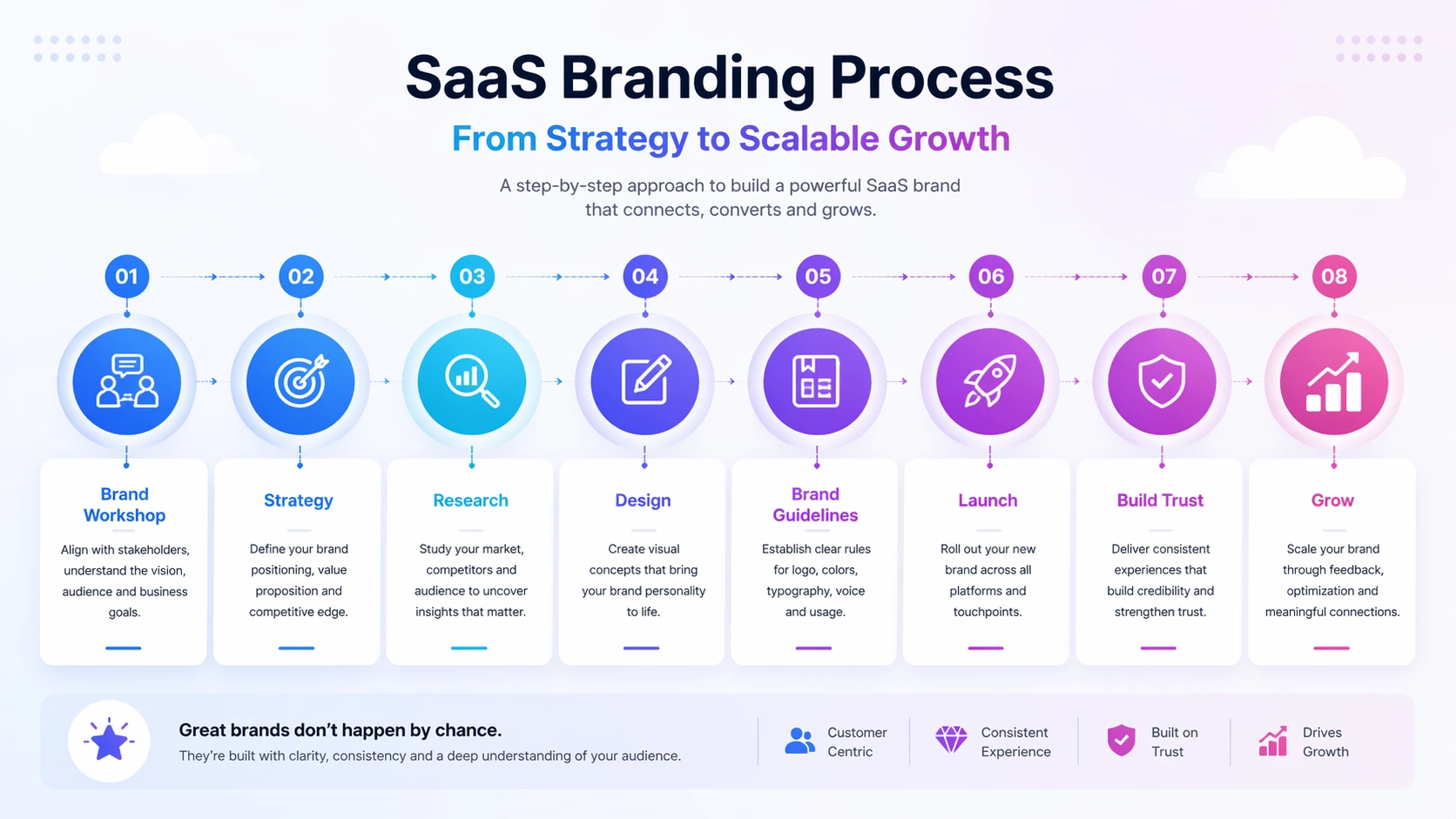
Step 1: Conduct a Brand Workshop
Before anyone opens a design tool or writes a tagline, bring together the key stakeholders: founders, product leads, marketers, and ideally a few customers. A brand workshop is a structured session to align on the company's mission, values, audience personas, and competitive differentiation. The output is not a brand. It is the raw material a brand gets built from. Without this step, everything that follows is guesswork.
Step 2: Develop Your SaaS Brand Strategy
Benchmark against the best hospital website designs in your region and specialty. Identify gaps in your current site where patients drop off. What information is hard to find? Use tools like Hotjar or Microsoft Clarity for behavioral data. Brand strategy translates workshop insights into decisions. This includes defining your brand positioning, naming your archetype, writing your brand promise, and establishing the personality traits your company will express. Think of it as writing the constitution for your brand. Every future design and copy decision gets measured against it. A clear strategy also prevents the brand from drifting every time a new team member joins or a new campaign is launched.
Step 3: Conduct Competitor Research and Create Mood Boards
Audit the visual and verbal landscape of your category. How do competitors present themselves? What colors dominate? What language do they use? The goal is not to copy; it is to differentiate. Once you understand the category conventions, you can choose where to align and where to deliberately stand apart. Mood boards then help translate strategic intent into visual direction before any actual design work begins. This saves time and reduces expensive revision cycles.
Step 4: Develop Design Concepts and Map Brand Touchpoints
Now the creative work begins. Design concepts explore multiple visual directions for the brand before committing to one. At the same time, map every touchpoint where your brand will appear: website, product UI, sales decks, email templates, social profiles, onboarding screens, invoices, and even Zoom backgrounds. This inventory ensures the design system you build is practical, not just pretty. Best saas branding always thinks in systems, not individual assets.
Step 5: Establish Brand Guidelines and Rules
Brand guidelines are the rulebook every team member, contractor, and partner uses to present the brand correctly. They should cover logo usage, color codes, typography pairings, photography style, tone of voice examples, and messaging frameworks. The best guidelines are not restrictive documents; they are enabling ones. They give people enough structure to move fast without breaking things.
Step 6: Launch and Monitor Your New Brand
Launching a brand is not a one-time event. It is an ongoing commitment. Announce the rebrand with intention, explaining the "why" to your existing users and the market. Then monitor brand perception through NPS surveys, user interviews, social listening, and brand search volume. A brand is not static. It evolves as your product, market, and users evolve. Build feedback loops from day one.
Fostering Trust and Authenticity with Your SaaS Audience
Users can tell when a brand is performing versus when it is genuine. The difference shows up in how a company handles outages, how it responds to negative reviews, how it treats freemium users, and how honest it is about product limitations. Authenticity is not a marketing strategy. It is a cultural commitment that gets expressed through brand behavior.
Trust is also built through proof, not just promises. Case studies, transparent pricing, security certifications, customer testimonials, and published product roadmaps all signal that a company is serious and accountable. The more you show your work, the faster users move from skepticism to confidence.
There is a reason companies like Basecamp, Figma, and Intercom have such loyal user bases. They built brands grounded in real opinions and consistent behavior, not polished marketing speak. Your saas brand should do the same. Speak plainly. Deliver consistently. Own your mistakes publicly.
What Services Does a SaaS Branding Agency Offer?
A SaaS Branding Agency does not just deliver a logo and a style guide. The right branding agency for saas companies offers an end-to-end brand-building service that connects strategy with execution.
- Brand strategy and positioning workshops to align leadership and define competitive differentiation.
- Visual identity design, including logo, color system, typography, iconography, and illustration style.
- Messaging and copywriting frameworks that ensure consistent language across sales, marketing, and product.
- Website design and development that translates the brand identity into a high-converting digital experience.
- Product UI and UX branding to ensure visual consistency between marketing and the actual product.
- Brand guidelines documentation that enables internal teams and external partners to apply the brand correctly.
- Ongoing brand management and evolution as the company scales, enters new markets, or launches new products.
SaaS Branding Best Practices and Common Pitfalls to Avoid
The best saas branding is built with discipline, not just creativity. Here are the habits that separate strong brands from forgettable ones.
What to do:
- Start with strategy before design. Aesthetics without positioning leads to a beautiful brand that says nothing.
- Build for consistency across every touchpoint, from your pricing page to your 404 error screen.
- Treat the brand as a team-wide responsibility, not just a marketing function.
- Revisit and evolve your brand as your product and market position mature.
What to avoid:
- Rebranding every time you hire a new designer. Frequent identity changes destroy recognition.
- Copying competitor aesthetics. Looking like everyone else makes you invisible.
- Ignoring brand voice. A visually polished brand with inconsistent copy feels untrustworthy.
Treating brand guidelines as a one-time deliverable instead of a living document.
Final Thoughts to Scale Your SaaS Brand
A powerful SaaS branding strategy is not something only available to funded startups or large enterprises. It's a growth tool accessible to any company willing to put thought before action. Your brand isn't just what you claim it to be. It's what users experience when they use your product, read your emails, and share their thoughts with others. Get that experience right, and the rest of your growth strategy will flow more smoothly.
Ready to create a brand that builds trust on a large scale? Start by reviewing what your brand is currently communicating, and ask yourself honestly if it aligns with who you are and where you're headed.
At Upclues, a top Branding & UI/UX Design Agency, we help SaaS companies do exactly that: build brands with clarity, consistency, and confidence that turn first-time visitors into loyal, long-term users.
Ready to refresh your brand?
Contact Upclues today and start your branding journey.