



Top 10 B2B Website Design Trends for 2026
April 21, 2026
SaaS Branding: Why Identity is Your Secret Weapon for User Trust
May 1, 2026Top 10 B2B Website Design Trends for 2026
April 21, 2026SaaS Branding: Why Identity is Your Secret Weapon for User Trust
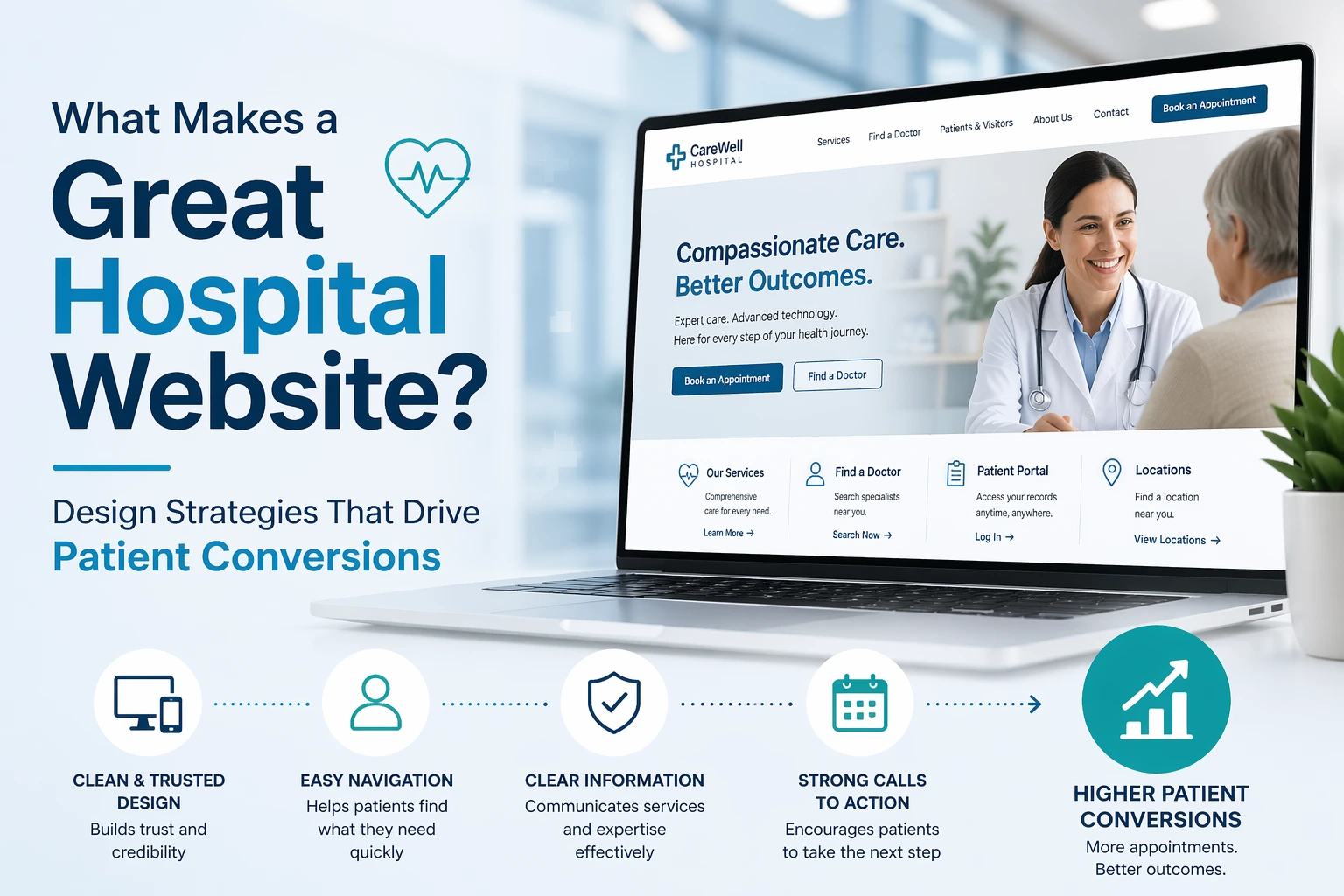
May 1, 2026What Makes a Great Hospital Website? Design Strategies That Drive Patient Conversions
April 24, 2026
- 15 min to Read
Quick-Read
- What hospital web design actually involves
- The compliance and ethical rules every hospital site must follow
- What separates the best hospital websites from average ones
- A step-by-step process to build or redesign your hospital website
- Actionable optimization tips to sustain long-term performance
Introduction
Hospital web design directly determines whether a patient books with you - or your competitor.
77% of patients search online before scheduling a hospital appointment. Your website is that first impression. And most hospital websites fail it - slow load times, cluttered navigation, no clear next step.
What makes a good hospital website? One that combines clinical credibility, intuitive UX, and a clear path to action - so patients move from searching to scheduled, fast.
This guide will show you exactly how to build one.
What Is Hospital Web Design?
Hospital web design is the process of planning, structuring, and building a digital experience that serves both patients and healthcare providers effectively.
But here's where most people get it wrong: hospital web design is not just about picking the right color palette or uploading doctor headshots. It is a multi-layered discipline that combines:
- Information architecture: organizing departments, services, specialties, and doctor profiles so patients find what they need instantly
- Patient portal integration: seamless access to health records, test results, and appointment history
- Online appointment booking: frictionless scheduling that reduces call center dependency
- Compliance-ready infrastructure: HIPAA-aligned forms, secure data handling, and privacy-first design
- Accessibility standards: ensuring every user, regardless of ability, can navigate the site with ease
- Clinical credibility signals: accreditations, doctor credentials, and patient outcome data presented clearly
What separates medical website design from general web design is the stakes involved. A poorly designed e-commerce site loses a sale. A poorly designed hospital website loses patient trust and, in some cases, delays critical care.
Every design decision must serve one primary goal: making it easier for patients to access the care they need.
Ethical and Regulatory Foundations in Healthcare Design
6Before a single pixel is placed, hospital websites must operate within a strict ethical and legal framework. Ignoring this doesn't just create legal liability; it actively destroys patient trust.
HIPAA compliance
It is the baseline for any hospital website that collects patient information. This includes:
- Appointment booking forms and contact submissions must use encrypted, HIPAA-compliant tools; standard form builders simply do not qualify
- Patient data must never be stored in unsecured third-party environments
- SSL certificates are mandatory across every page, not just the homepage
- Tracking pixels (Meta Pixel, Google Analytics) must be configured carefully to avoid capturing protected health information
ADA and WCAG 2.1 Level AA compliance
This compliance is equally non-negotiable. Hospitals serve patients with visual, auditory, and cognitive disabilities. Your website must accommodate all of them. Key requirements include:
- Descriptive alt text on all images
- Full keyboard navigability for users who cannot use a mouse
- Sufficient color contrast ratios across all text and UI elements
- Captions on all video content
Non-compliance isn't just an ethical failure. ADA lawsuits against healthcare websites are rising sharply, making accessibility a financial risk as much as a moral one.
Medical Content Ethics & Google E-E-A-T Alignment
Every piece of content in healthcare website design must be accurate, reviewed, and responsibly presented - especially when patients are making decisions about their care. This means:
- No exaggerated claims about treatment success rates or patient outcomes
- All medical information is reviewed and approved by licensed practitioners
- Clear authorship and credential disclosures on clinical content
- No fear-based messaging designed to push patients toward unnecessary services
This directly aligns with Google's E-E-A-T framework: Experience, Expertise, Authority, and Trust. Hospitals that demonstrate genuine clinical credibility in their content rank higher and convert better.
Ethical UX: Designing for Patients, Not Just Conversions
Dark UX patterns have no place in healthcare design. Specifically:
- Emergency contact numbers and crisis helplines must always be prominently visible
- Pricing and wait time information should never be hidden behind excessive clicks
- Patients should never be manipulated toward higher-cost services through deceptive design
With compliance as your foundation, here is what actually separates a good hospital website from a truly great one.
Effective Web Design Strategies for Hospital Brands
1. Lead With Empathy-Driven Design
Patients visiting a hospital website are often anxious, unwell, or making decisions on behalf of someone they love. Your design must immediately communicate calm, competence, and care. Use real staff photography over stock images. Use warm, trustworthy color palettes. Lead with patient outcomes, not institutional achievements.
2. Make Doctor Profile Pages a Priority
Doctor profile pages consistently rank among the highest-traffic pages on any hospital website. Patients search for specific physicians by name. Each profile should include credentials, specialties, languages spoken, patient reviews, and a direct booking link. Treat every doctor page as a standalone landing page.
3. Build Condition and Symptom-Based Content Hubs
Instead of organizing content solely around departments, create patient-facing content hubs based on conditions and symptoms. A patient searching "chest pain specialist near me" is not thinking in terms of your cardiology department structure; they are thinking about their symptom. Aligning your content architecture with patient language is one of the highest-ROI moves in hospital website development.
4. Integrate Video Content Strategically
Virtual facility tours, physician introduction videos, and procedure explainers significantly reduce patient anxiety and increase the time patients spend on site. Both factors positively influence conversion rates and SEO performance.
5. Invest in Local SEO Integration
Website design for hospitals must account for local search signals from the ground up. This means embedding Google Maps, creating location-specific service pages, maintaining a complete Google Business Profile, and using structured schema markup for your organization and physicians. Most hospital patients are local; your design should reflect that.
6. Add Live Chat or an AI-Powered Chatbot
Patients have questions at 11 pm that your front desk cannot answer. A well-configured chatbot handles appointment inquiries, FAQs, department directions, and insurance questions around the clock. This reduces bounce rate, improves patient experience, and decreases administrative burden simultaneously.
Ready to refresh your brand?
Contact Upclues today and start your branding journey.
Step-by-Step Guide to Creating a Hospital Web Design
Whether you are building from scratch or redesigning an existing site, this process ensures nothing critical is missed.
Step 1: Define Goals and Patient Personas
Before any design work begins, identify who visits your site and what they need. A first-time patient finding a GP has a completely different journey from a specialist referral patient. Map these personas and design for each one.
Step 2: Conduct a Competitor and UX Audit
Benchmark against the best hospital website designs in your region and specialty. Identify gaps in your current site where patients drop off. What information is hard to find? Use tools like Hotjar or Microsoft Clarity for behavioral data.
Step 3: Plan Your Site Architecture
Map every page before designing a single screen. Core sections include: Services, Departments, Find a Doctor, Patient Portal, About Us, Blog, Careers, and Contact. Every page should have a defined purpose and a clear next step.
Step 4: Choose the Right Technology Stack
For most hospitals, WordPress with a healthcare-specific framework or Drupal offers the right balance of flexibility and compliance capability. Ensure your hosting environment is HIPAA-eligible, and your form and booking tools are certified compliant.
Step 5: Design Mobile-First
Wireframe and prototype on mobile screen sizes before scaling to desktop. This forces design discipline; if it works on mobile, it works everywhere. Mobile-friendly hospital website design is not a feature; it is the foundation.
Step 6: Build Trust Elements In From the Start
Accreditations, patient testimonials, outcome statistics, and physician credentials should be integrated into the design system, not added as afterthoughts. Trust signals placed in the right locations at the right moments in the patient journey have a direct impact on conversion rates.
Step 7: Integrate Key Patient-Facing Functionality
This includes appointment booking systems, patient portal access, site-wide search, insurance verification tools, and telehealth integration where applicable. Each one must be tested rigorously for usability and compliance.
Step 8: Test Thoroughly Before Launch
Run cross-browser and cross-device testing. Check all forms for HIPAA compliance. Audit accessibility against WCAG 2.1 standards. Test page speed using Google PageSpeed Insights. Validate every CTA link. Do not rush this step.
Step 9: Launch, Monitor, and Iterate
Post-launch is where long-term performance is won or lost. Set up Google Analytics 4, Search Console, and heatmap tracking from day one. Establish a monthly review cadence to track rankings, conversion rates, and user behavior, and optimize accordingly.
Optimization Tips for Hospital Web Design
Building a great hospital website is not a one-time project. Here are the optimization practices that sustain and improve performance over time.
- Core Web Vitals: Optimize your Largest Contentful Paint (LCP), Interaction to Next Paint (INP), and Cumulative Layout Shift (CLS) scores. These directly influence Google rankings and user experience quality
- Schema Markup: Implement Medical Organization, Physician, and Medical Clinic schema to improve your visibility in rich search results and Google's knowledge panels
- Image Optimization: Compress all medical and facility imagery using next-gen formats (WebP). Large uncompressed images are the single most common cause of slow hospital websites
- Internal Linking Strategy: Connect service pages to relevant blog content, doctor profiles to department pages, and condition hubs to appointment booking flows. This improves both SEO authority and patient navigation
- Conversion Rate Optimization: A/B test your primary CTAs, form placements, and appointment booking flows regularly. Small changes in button placement or copy can produce significant conversion lifts
- Content Freshness: Google rewards regularly updated medical content. Assign a clinical reviewer to audit existing pages quarterly and publish new condition or treatment content consistently
- Security and SSL: Maintain active SSL certificates across all subdomains. Run regular vulnerability scans, especially on patient-facing forms and portal entry points
- Quarterly SEO Audits: Review rankings, crawl errors, broken links, and page performance every quarter. Hospital web design is a living system, not a finished product.
Final Thoughts
A hospital website is not a digital brochure. It is your patient's first impression, and that impression determines whether they book with you or move on.
Great healthcare website design lives at the intersection of patient empathy, regulatory compliance, and conversion strategy. When all three work together, trust is built before a patient ever walks through your doors. If your website is not converting visitors into patients, the problem is structural, not cosmetic. It is fixable, but only with the right expertise behind it.
At Upclues, a Branding & UI/UX agency, we help healthcare brands build websites that patients trust and search engines reward from compliance-ready architecture to conversion-focused design systems.