



A Complete Guide to SEO for Fashion Ecommerce Success
July 17, 2026
Proven Tips for a Successful WordPress Website Redesign
July 21, 2026A Complete Guide to SEO for Fashion Ecommerce Success
July 17, 2026Proven Tips for a Successful WordPress Website Redesign
July 21, 2026SEO for Manufacturing Companies: A Simple, Complete Guide (2026)
July 18, 2026
- 15 min to Read
Short answer
SEO for manufacturing companies means making your website easy for both search engines and buyers to find, understand, and trust - so that when someone searches "CNC machine shop near me" or "ISO certified die caster," your company shows up first, not your competitor's.
This guide breaks the whole process down in plain English. No jargon walls, no fluff - just what manufacturers actually need to do, in order, with real examples.
1. What Is SEO for Manufacturing Companies?
SEO (Search Engine Optimization) is the practice of improving your website so it ranks higher in Google, Bing, and increasingly, in AI tools like ChatGPT and Google's AI Overviews, when someone searches for what you make or the service you offer.
Think of it like this: your factory floor might be spotless and your quality certifications world-class, but if a purchasing manager Googles "sheet metal fabricator in Ohio" and your website is nowhere on page one, that lead goes to a competitor instead - even if your work is better.
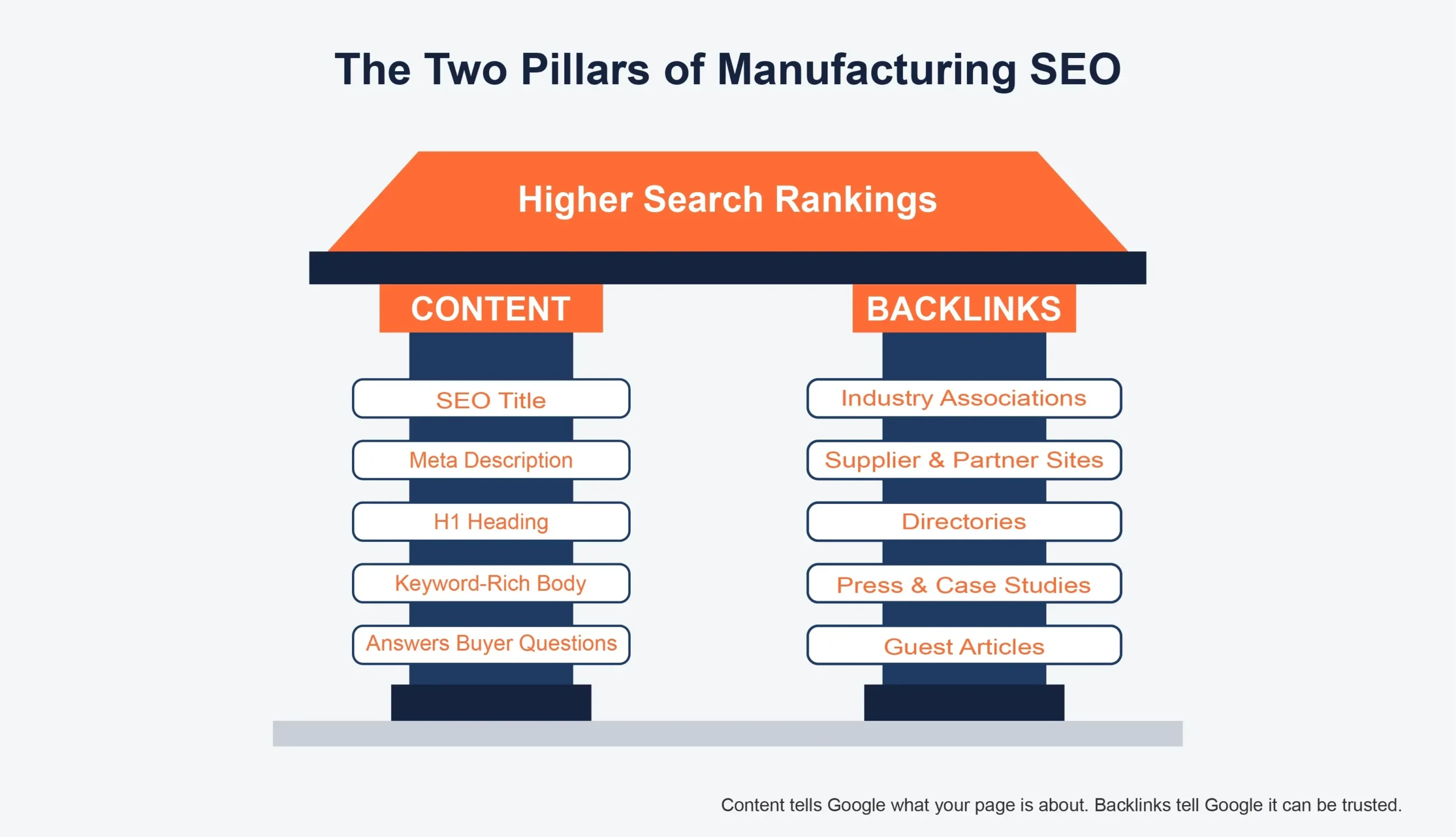
SEO rests on two pillars:
- Content - pages built around the exact terms your buyers are searching for.
- Authority - trust signals (mainly backlinks) that tell Google your site is credible enough to show first.
We'll unpack both below, but first, here's why this actually matters for your bottom line. For a deeper technical breakdown, Google's own SEO Starter Guide is a useful primer alongside this article.
2. Why Manufacturers Can't Afford to Skip SEO
Manufacturing buyers behave differently than they did ten years ago. Procurement teams, engineers, and OEM sourcing managers now research and shortlist vendors online long before they ever pick up the phone - a pattern well documented in Google and Think with Google's research on the B2B and industrial buyer journey.
Here's what typically happens to manufacturers on either side of this shift:
| Without SEO | With SEO |
|---|---|
| Relies on repeat customers, referrals, and trade shows | Generates new inbound leads every month |
| Invisible when a new buyer searches for your service | Shows up for high-intent searches like "contract machine shop Illinois" |
| Vulnerable during slow seasons or economic downturns | Has a steady lead pipeline regardless of the economy |
| Competes only on relationships | Competes for buyers who don't know you exist yet |
A simple example: A metal stamping company that ranks #1–3 for "metal stamping manufacturer [state]" will typically capture the large majority of clicks for that search - studies on search click-through rates consistently show the top three organic results earn the lion's share of traffic, while page two is rarely seen at all. If you're not there, you're invisible to that buyer.
This is also why website quality and SEO have to work together. A page that ranks well but doesn't clearly communicate your certifications, capabilities, and value proposition will still lose the lead. This is the gap Upclues closes for industrial clients - pairing a brand and website that build instant trust with the SEO strategy that gets buyers there in the first place.
3. How SEO Actually Works: Real Search Examples
SEO isn't theoretical - real people are typing real searches every day, looking for manufacturers exactly like you. Examples pulled from actual buyer search behavior:
- "ISO 9001 certified injection molder"
- "heavy fabrication services near me"
- "AS9100 certified machine shop for aerospace parts"
- "bronze casting company"
- "contract manufacturer for medical devices"
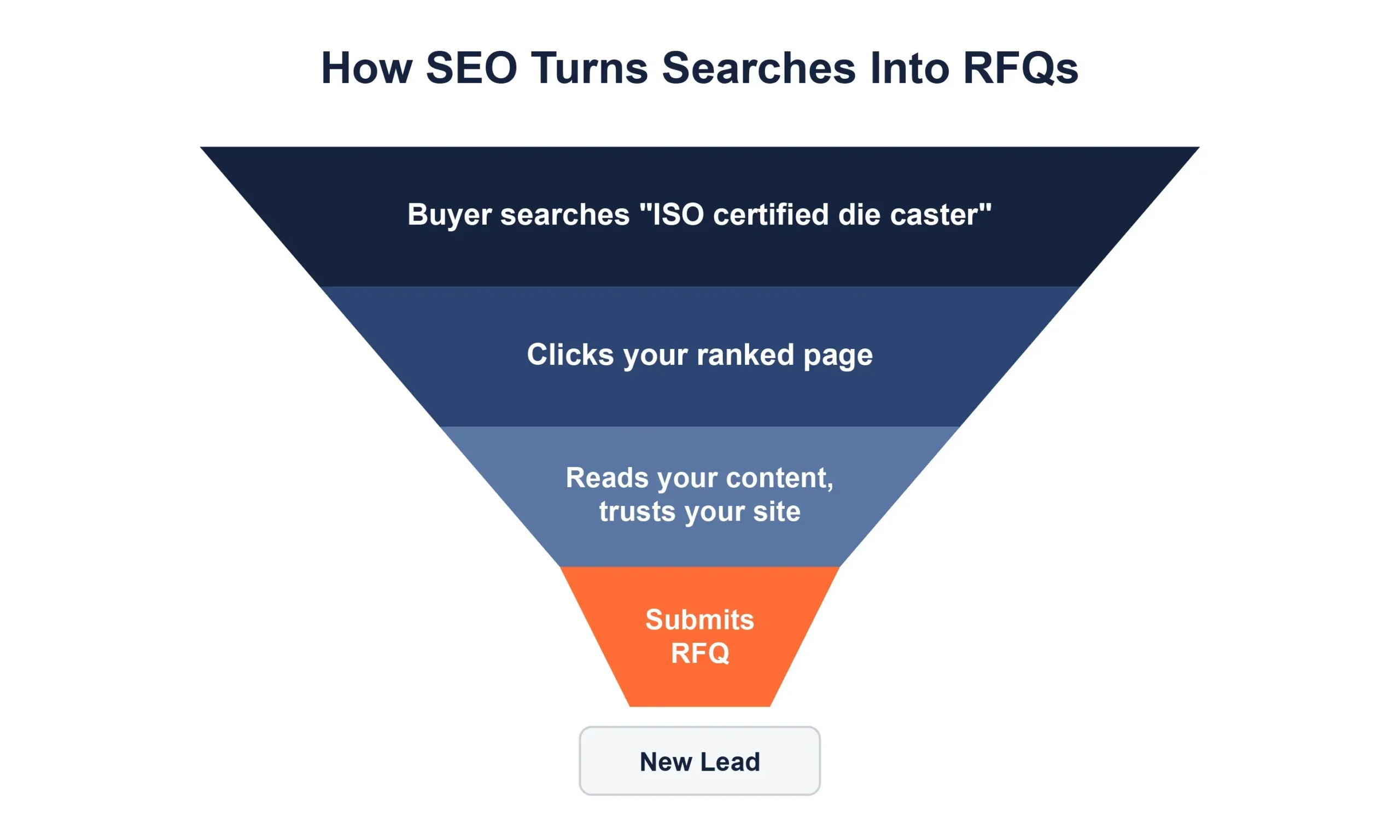
How you prove it's working: Set up a conversion goal in Google Search Console and Google Analytics - for example, tracking every Request for Quote (RFQ) form submission on your "CNC machining" page. Over time, you can see exactly which keywords brought in the visitor who filled out that form. That's the direct link between ranking and revenue.
This is the exact funnel we help clients build and measure as part of our SEO services - ranking isn't the finish line, a submitted RFQ is.
Ready to refresh your brand?
Contact Upclues today and start your branding journey.
4. The Two Pillars of Manufacturing SEO
4.1 Pillar One: Content (On-Page SEO)
Google's crawlers scan your page to understand what it's about. There are four places you must place your target keyword for Google (and AI search tools) to correctly understand and rank your page:
- SEO Title (Title Tag) - appears in the browser tab and as the clickable blue link in search results. Example: "CNC Machining Services in Ohio | ISO 9001 Certified Machine Shop"
- Meta Description - the short summary under your title in search results. It won't directly boost rankings, but a compelling one improves your click-through rate.
- H1 (Page Heading) - the main, largest heading on the page. Should closely match the title.
- Body Content - your target keyword (and natural variations of it) should appear several times across at least 500–1,000+ words of genuinely useful content - not stuffed in awkwardly, but written the way you'd explain your capability to a real customer.
How to pick the right keyword:
- Identify the service. E.g., if you do CNC machining, your core keyword might be "contract machine shop" or "CNC machining company."
- Check the competition. Google your target term and see who's already ranking. If the same 10 established companies dominate page one, you may need a more specific, less competitive variation first (this is called a "long-tail keyword" - e.g., "small batch CNC machining for medical devices" instead of just "CNC machining").
- Think like your buyer, not like your business. An aerospace OEM won't search "aerospace machining services" - they'll search "machine shop with AS9100 certification." Match the buyer's language, not your internal terminology.
You can find real search terms your ideal customers use through free tools like Google Search Console (shows what people already searched to find you), Google Keyword Planner (estimates search volume for new terms), and Google Trends (shows how demand for a term is rising or falling over time).
Getting the message right on the page matters just as much as the keyword itself - this is where SEO content and brand messaging overlap. Our brand strategy work often feeds directly into how we write SEO pages, so the language ranks and actually persuades a buyer once they land.
4.2 Pillar Two: Authority (Off-Page SEO / Backlinks)
A backlink is simply another website linking to yours. Google treats backlinks as "votes of trust" - if a credible site links to you, Google assumes your site must be credible too. This is one of the ranking factors Google and independent studies (such as Moz's Search Engine Ranking Factors research) consistently identify as among the most influential.
Even perfectly written content struggles to rank without any backlinks, because your competitors likely have pages targeting the same keywords - Google needs a tiebreaker, and authority is often it.
Realistic ways manufacturers earn backlinks:
- Industry associations. Joining a manufacturers' association or regional trade group often includes a member directory listing that links back to your site.
- Supplier and partner pages. If you're a preferred supplier or vendor for another company, ask if you can be listed with a link on their "Partners" or "Suppliers" page.
- Local and industry directories. Business directories relevant to manufacturing, such as Thomasnet and IndustryNet, plus your local chamber of commerce, are common, accessible sources.
- Press mentions and case studies. If you complete a notable project, local business journals or trade publications may cover it - and link to you. Guest content or interviews. Contributing an article or being interviewed for an industry podcast or blog is another natural way to earn a relevant link.
Backlink research tools like Ahrefs or Semrush let you see exactly where your competitors are getting their links - often the fastest way to find realistic opportunities for your own site.
5. Technical SEO: The Foundation Buyers Never See
Content and backlinks get most of the attention, but a technically broken website undermines both. At minimum, manufacturers should check:
- Site speed - test your site with Google PageSpeed Insights. Slow-loading pages hurt both rankings and conversions.
- Mobile-friendliness - a growing share of B2B research happens on phones, especially early in the buyer journey.
- Secure connection (HTTPS) - a basic trust and ranking signal. Structured data (Schema markup) - code that helps search engines (and AI tools) understand exactly what your business does, your certifications, service areas, and reviews. See Schema.org for the standard vocabulary.
- Accessibility - descriptive image alt text and clear page structure aren't just good for accessibility (WCAG guidelines); Google has increasingly rewarded rich, well-structured, accessible content in rankings.
If your website is outdated, slow, or wasn't built with SEO in mind, no amount of content will fully compensate. This is a common gap Upclues addresses through dedicated web design and WordPress development - building the technical foundation before layering content and links on top. Google's Core Web Vitals documentation is a good reference if you want to understand exactly which speed and stability metrics Google measures.
6. Don't Forget Local SEO
Many manufacturers serve a specific region, state, or driving radius, even if they also ship nationally. If that's you, claim and fully optimize your free Google Business Profile - following Google's own Business Profile optimization guidance to add your certifications, service categories, photos of your facility, and encourage satisfied customers to leave reviews. This directly influences whether you show up in local map results for searches like "machine shop near me."
7. SEO in the Age of AI Search (AEO)
Search behavior is changing again. Buyers now often ask AI tools like ChatGPT, Google's AI Overviews, or Perplexity questions like "Who are the best ISO-certified injection molders in Texas?" instead of typing a traditional search.
This is sometimes called Answer Engine Optimization (AEO) or Generative Engine Optimization (GEO). The good news: the fundamentals overlap heavily with traditional SEO. AI tools favor:
- Clear, well-structured content that directly answers specific questions
- Pages with genuine expertise, certifications, and real data (not generic marketing copy)
- Sites with strong backlink authority, since AI tools often pull from already well-ranked sources
Manufacturers who build genuinely informative content now are positioning themselves for both traditional search and this AI-driven shift. Google's own guidance on creating helpful, reliable, people-first content applies directly here - AI tools and traditional search are converging on the same standard: real expertise, clearly explained.
8. Common SEO Mistakes Manufacturers Make
- Writing for yourself, not your buyer. Using internal jargon instead of the terms your customer actually searches.
- Publishing once and forgetting it. SEO is ongoing - Google rewards sites that consistently add relevant, useful content.
- Ignoring backlinks entirely. Strong content with zero authority signals rarely outranks established competitors.
- Skipping technical basics. A slow or broken site undercuts every other effort.
- Expecting overnight results. Meaningful SEO results typically build over 3–6 months, not days.
9. A Simple 90-Day Manufacturing SEO Roadmap
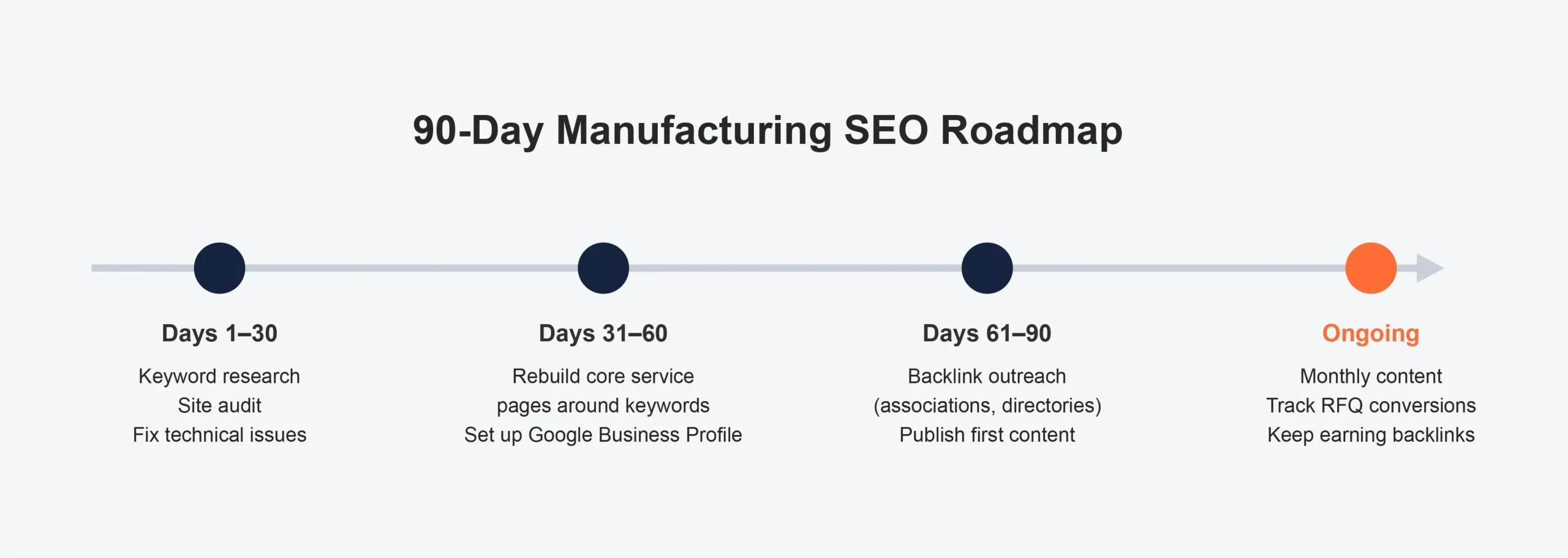
This is roughly the same process our team follows when we onboard a new manufacturing client, adjusted based on how competitive your specific industry and region are.
| Timeframe | Focus |
|---|---|
| Days 1–30 | Keyword research; audit existing pages; fix technical issues (speed, mobile, HTTPS) |
| Days 31–60 | Rewrite or build core service pages around target keywords; set up Google Business Profile and analytics tracking |
| Days 61–90 | Begin backlink outreach (associations, directories, partners); publish first pieces of ongoing content |
| Ongoing | Publish new content monthly; monitor rankings and RFQ conversions; keep earning backlinks |
10. Key Takeaway
Manufacturing SEO isn't complicated once you strip away the jargon: build genuinely useful content around the exact terms your buyers search for, and earn credible backlinks that prove your authority. Add a technically sound, fast, mobile-friendly website, and you have everything you need for consistent, compounding lead generation - in good economic times and bad.
Want Help Building Your Manufacturing SEO Strategy?
At Upclues, we help manufacturers build a complete digital presence with a high-performance website, strategic branding, and data-driven SEO that converts organic traffic into qualified RFQs. Explore our branding services for manufacturing companies, manufacturing website design, and SEO for Manufacturing services to strengthen your online presence and generate more leads. Book a free strategy call to discover how your website can perform better.
Looking for more expert insights? Visit the Upclues Blog for practical guides on manufacturing branding, website design, SEO, and digital marketing strategies to help your business grow.
FAQs
Is SEO better than paid ads (PPC) for manufacturers?
Both can generate leads, but they work differently. SEO builds lasting visibility that continues working even if you pause investment, while PPC visibility stops the moment you stop paying. Many manufacturers use both together for the fastest results - alongside supporting channels like social media marketing to reinforce brand recognition when a buyer eventually does search for you.
How long does manufacturing SEO take to show results?
Most manufacturers start seeing meaningful ranking movement in 3–6 months, with compounding results over a year or more, since it depends on your industry's competitiveness and your starting point.
Can I do SEO myself?
Yes, if you can commit consistent time (research suggests a realistic minimum of several hours per month) to keyword research, writing, and outreach. Many manufacturers start DIY and bring in specialists once they need faster, more consistent results.
Does a new website help SEO?
Yes - a modern, fast, mobile-friendly site with dedicated pages for each core service or product gives your SEO efforts a much stronger foundation than an outdated site.
Ready to refresh your brand?
Contact Upclues today and start your branding journey.