



SEO for Travel Websites: The Complete Guide to Higher Rankings
August 14, 2026
Top Backlink Strategy Medical Clinic Healthcare Seo Tactics
August 25, 2026SEO for Travel Websites: The Complete Guide to Higher Rankings
August 14, 2026Top Backlink Strategy Medical Clinic Healthcare Seo Tactics
August 25, 2026SEO for the healthcare industry
August 19, 2026
- 18 min to Read
Quick-Read
- Healthcare SEO combines search visibility with HIPAA-aware, trust-driven content built specifically for patient decision-making, not generic keyword ranking.
- Patients research symptoms, providers, and treatment options online long before they book an appointment, making organic visibility a direct driver of patient volume.
- Eight core pillars, from technical SEO to Generative Engine Optimization, work together to help healthcare brands rank on Google and get cited by AI search tools.
- A well-run healthcare SEO strategy lowers patient acquisition costs over time and compounds in value, unlike paid ads that stop working the moment spend stops.
Introduction
A patient searching for a nearby clinic rarely calls the first name they know. They call the first result they trust. If your website isn't visible on that page, you lose the patient before they ever dial.
Research consistently shows patients now begin their healthcare journey with a search engine, not a phone call. Upclues helps clinics and hospitals close that gap through SEO for healthcare built around patient trust.
What Is Healthcare SEO?
Healthcare SEO is the process of optimizing a medical website so it ranks higher for the exact terms patients type when they need care. It blends traditional ranking factors with strict accuracy and compliance standards unique to medical content.
Unlike general SEO, healthcare seo strategy must account for E-E-A-T guidelines, since Google treats medical pages as YMYL (Your Money or Your Life) content. That means every claim needs medical accuracy, clear authorship, and a trustworthy source behind it.
Get it wrong, and rankings suffer. Get it right, and patients find you first.
Why Is SEO Necessary for the Healthcare Industry?
SEO is necessary for healthcare because most patients research symptoms, providers, and treatments online before booking an appointment. Without strong search visibility, clinics lose patients to competitors who rank higher, even if their care quality is lower. Healthcare seo strategy turns organic search into a reliable, cost-efficient channel for patient acquisition.
Patients no longer walk into the nearest clinic. They compare providers, read reviews, and check credentials first. A practice that doesn't show up in that research phase simply doesn't exist to that patient.
Industry data suggests a large majority of patients now use search engines as their first step when choosing a provider, well ahead of asking friends or family for referrals. That shift makes visibility non-negotiable, not optional.
A significant aspect of Effective SEO Content Writing is the trust it instills in medical SEO. Patients are not merely selecting a business; they are choosing someone to rely on for their health.
Three forces make SEO essential right now:
- Search-first behavior - Patients research before they call, so invisible clinics lose the decision before it's made.
- Rising competition - More clinics are investing in seo for medical practices, raising the bar for what "visible" means.
- AI-driven discovery - Search engines increasingly answer health questions directly, and only well-optimized sites get cited.
Skipping SEO doesn't mean staying neutral. It means losing ground to competitors who show up first.
Ready to refresh your brand?
Contact Upclues today and start your branding journey.
The Digital Shift in the Healthcare Industry
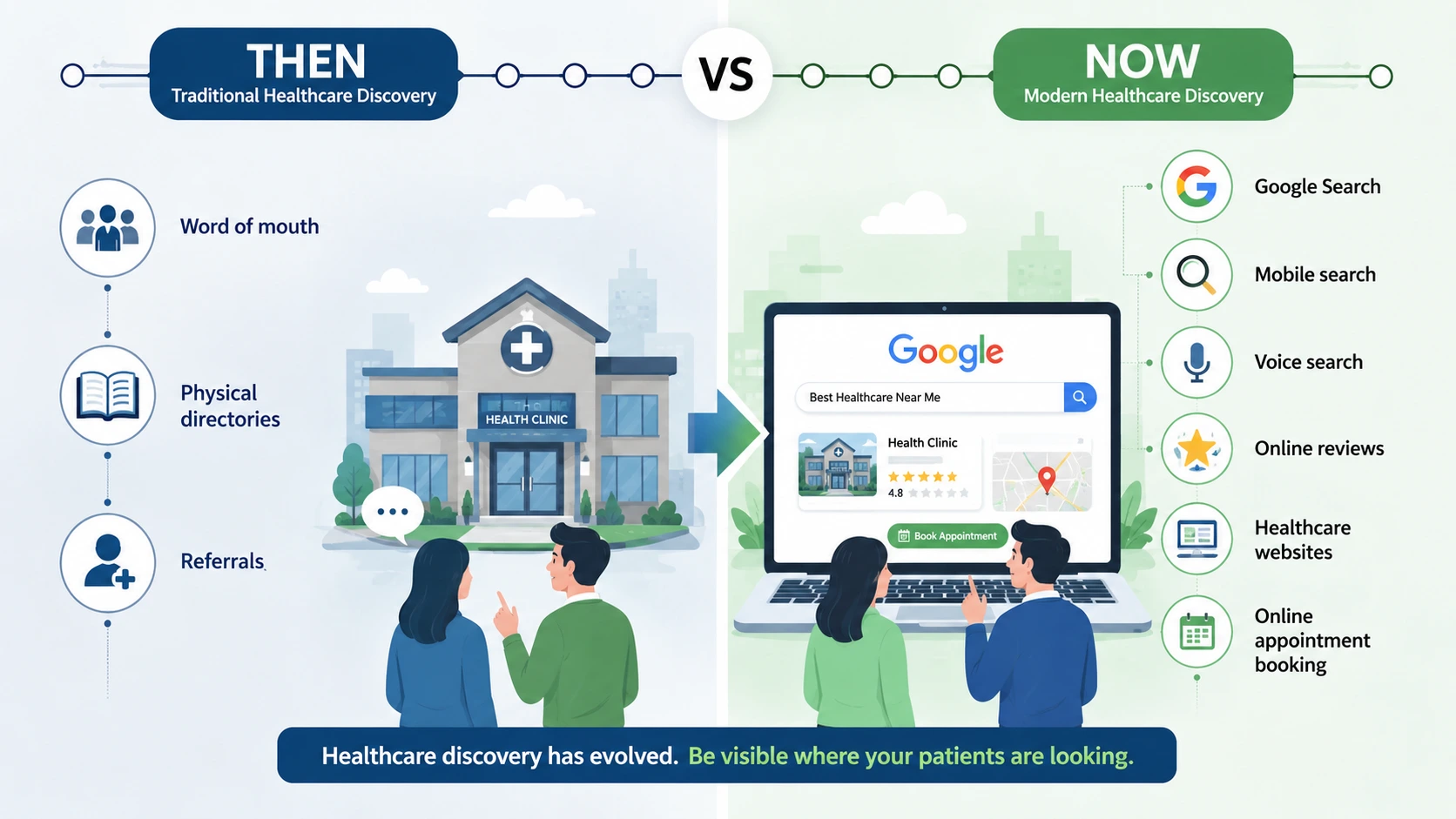
Healthcare used to be a local, word-of-mouth industry. That world has changed. Patients now expect the same digital convenience from their clinic that they get from any other business online.
Booking appointments, checking symptoms, and comparing providers now happen almost entirely on a screen. Mobile search plays a growing role in that shift, with more patients starting their healthcare research from a phone than a desktop.
Voice search adds another layer. Patients ask their devices questions like "urgent care near me open now" and expect a direct, accurate answer, not a list of links to sort through.
This shift rewards clinics that treat their website, backed by strong Local SEO, as a patient-facing front door, not a digital brochure. Healthcare seo becomes the bridge between a patient's first search and their first appointment.
Clinics that adapt early capture patients before competitors even appear in search results.
How Is Healthcare SEO Different from Standard SEO?
Healthcare SEO differs from standard SEO because it operates under stricter accuracy, compliance, and trust requirements. Google treats medical pages as YMYL content, meaning rankings depend heavily on author credentials, factual accuracy, and site trustworthiness, not just keywords and backlinks. Health seo also demands HIPAA-aware design choices that standard industries never have to consider.
A local bakery can rank with strong keywords, decent backlinks, and basic On-Page SEO. A clinic can't take that shortcut. One inaccurate claim on a medical page can cost both rankings and patient trust.
| Factor | Standard SEO | Healthcare SEO |
|---|---|---|
| Content accuracy | Helpful, general | Medically reviewed, fact-checked |
| Author trust | Optional | Required (E-E-A-T, credentials) |
| Compliance | Not applicable | HIPAA-aware design and forms |
| Local intent | Beneficial | Critical (near-me, symptom-based search) |
| Risk of errors | Low impact | High impact (patient safety, trust) |
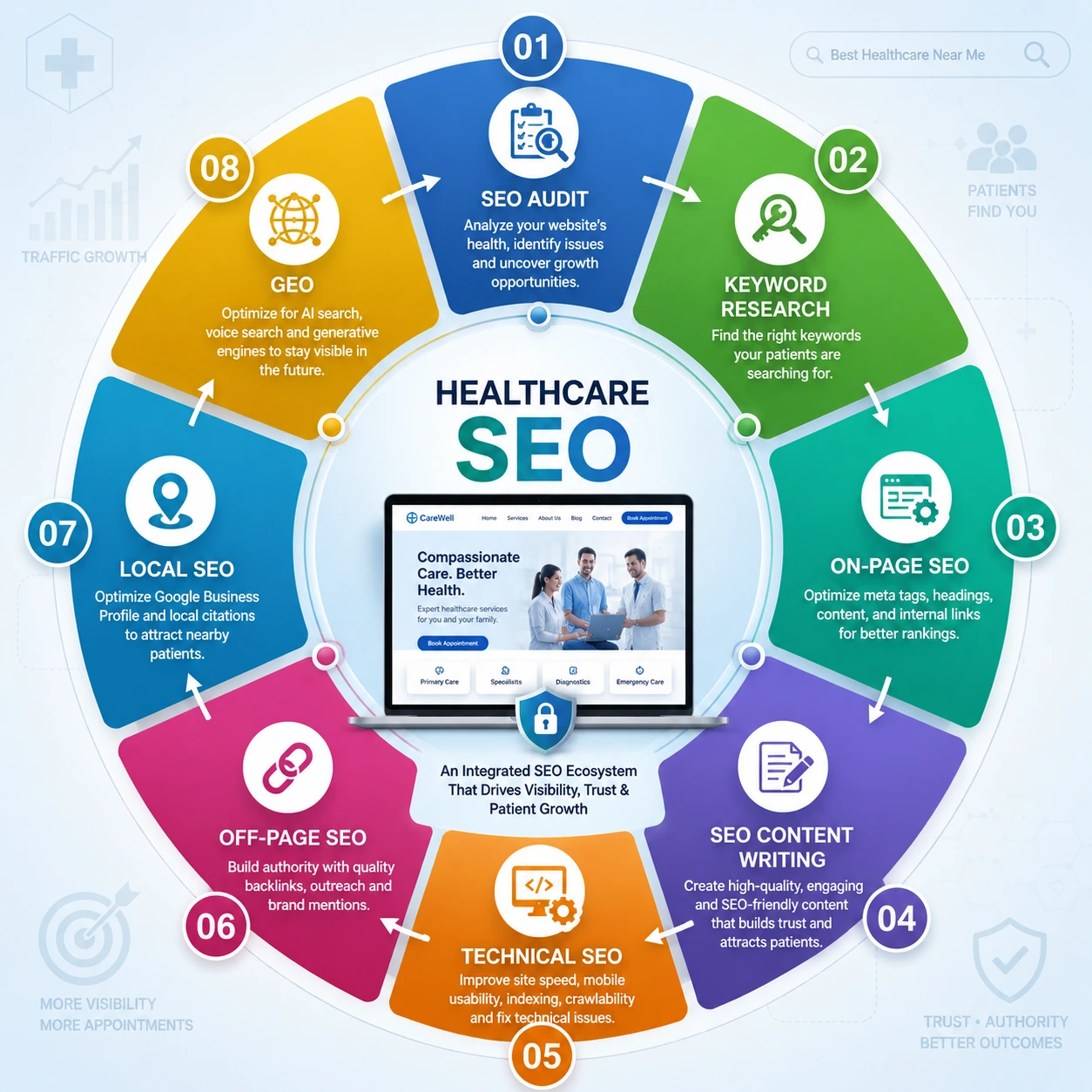
8 Core Pillars That Power Healthcare SEO
Healthcare SEO isn't one tactic. It's a system of eight connected pillars that work together to build visibility, trust, and patient conversions.
1. SEO Audit
Every healthcare seo strategy starts with an SEO Audit that uncovers technical errors, content gaps, and compliance risks before they cost rankings. A thorough healthcare seo audit reveals exactly where a site is losing patients.
2. Keyword Research
Keyword Research uncovers what patients actually search for, from symptoms to treatment names. Keyword research for healthcare focuses on intent, not just volume, since patients searching "chest pain causes" need different content than those searching "cardiologist near me."
3. On-Page SEO
On-Page SEO ensures that titles, headers, and page content are in harmony with the expectations of both patients and search engines. Strong on page seo services healthcare providers use structured content around real patient questions, not internal jargon.
4. SEO Content Writing
SEO Content Writing turns medical expertise into content patients can actually understand. Healthcare content writing balances clinical accuracy with plain language, so pages inform without overwhelming.
5. Technical SEO
Technical SEO ensures a site loads fast, works on mobile, and gets properly indexed. Technical seo for healthcare also covers HIPAA-aware form handling and secure page architecture.
6. Off-Page SEO
Off-page SEO builds authority through backlinks and mentions from trusted sources. Link building for healthcare relies on medical directories, associations, and press coverage, not generic guest posts.
7. Local SEO
Local SEO puts a clinic on the map, literally, for near-me searches. Local seo for healthcare depends on accurate listings, reviews, and location-specific content.
8. Generative Engine Optimization (GEO)
Generative Engine Optimization (GEO) structures content so AI tools like ChatGPT and Gemini can cite it directly. AI in healthcare seo means writing clear, factual answers AI engines can lift word-for-word.
Strategies for Healthcare SEO
A strong healthcare seo strategy isn't a single tactic. It's sixteen coordinated actions that compound over time into consistent patient volume, not a quick fix that fades once you stop paying attention to it. Sustainable growth comes from combining technical optimization, authoritative content, local visibility, and patient trust into one long-term digital marketing framework. When every element works together, your website becomes a reliable source of qualified patient inquiries rather than depending only on paid advertising.
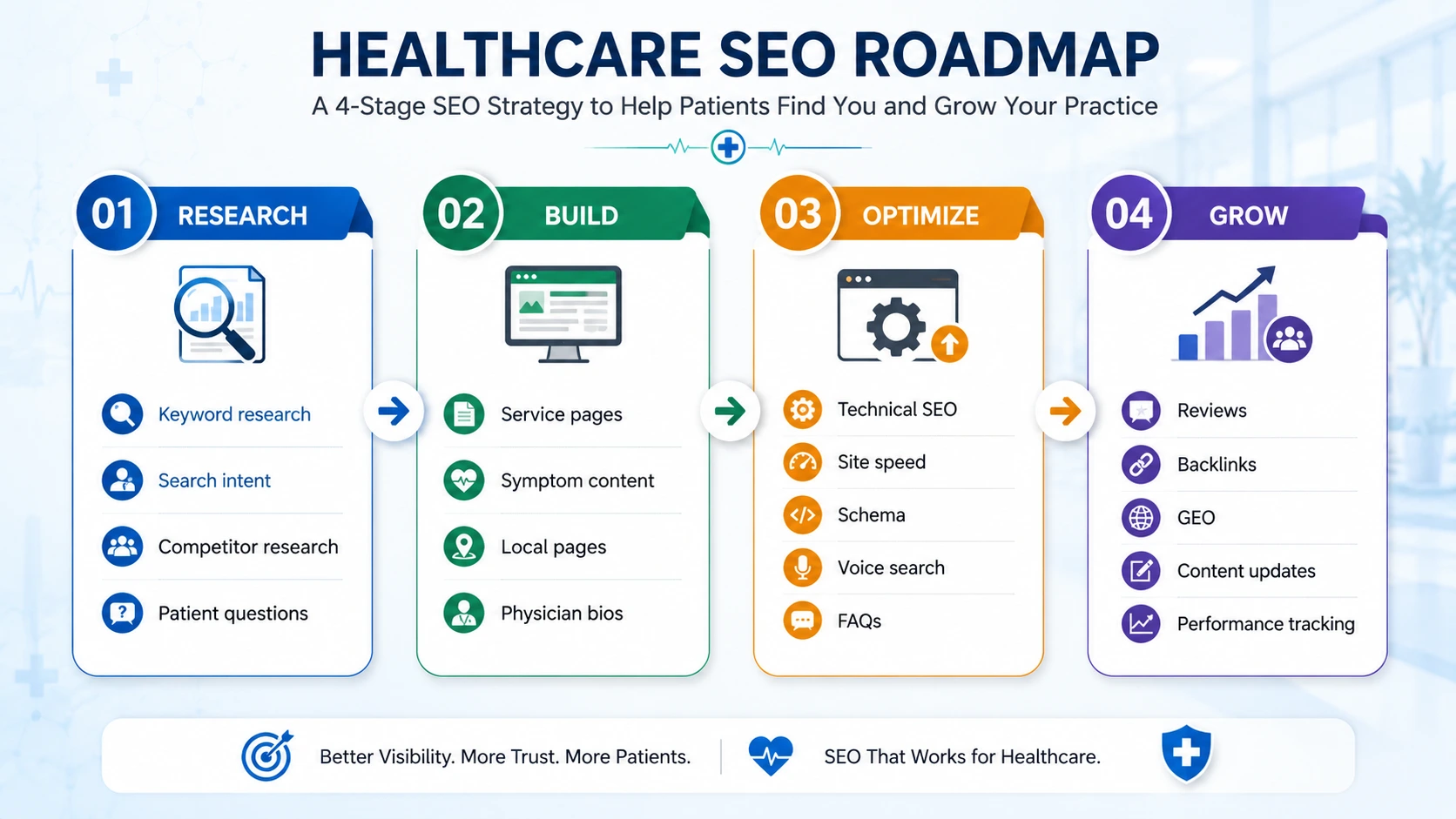
Foundational research and structure
-
Research healthcare-specific keywords:
Go beyond generic terms and map how patients actually phrase symptoms, conditions, and treatment questions in search bars. Understanding search intent allows you to create pages that answer real concerns instead of targeting broad, highly competitive keywords.
- Optimize Google Business Profile:
Accurate hours, services, categories, and photos directly influence whether a clinic appears in the local map pack. Keep contact information consistent across every online listing to strengthen local search signals.
-
Build E-E-A-T with bios:
Detailed physician bios with credentials, certifications, and specialties signal trust to both patients and Google's ranking systems. Adding awards, publications, and professional memberships further strengthens credibility.
-
Create symptom-based content pages:
Pages built around "why does my..." or "what causes..." searches capture patients early, before they've chosen a provider. Educational content also positions your practice as a trusted source of medical information.
Local and content-driven growth
- Target local city keywords:
Location-specific pages help clinics compete for "near me" and city-based searches instead of relying on one generic homepage. Tailor each page with unique content that reflects the community you serve.
- Earn medical directory backlinks:
Listings on trusted, industry-specific directories strengthen domain authority in ways generic backlinks never will. Focus on quality over quantity when building links.
- Improve site speed:
A slow-loading page loses patients before content ever renders, regardless of how strong that content is. Compress images, optimize code, and improve hosting performance for faster load times.
- Add schema for clinics:
Structured data helps search engines display hours, services, and reviews directly inside search results. It also improves the chances of earning rich results that attract more clicks.
Discovery and engagement
- Optimize for voice search:
Write in natural, conversational phrases that match how patients actually speak to voice assistants and smart devices. Focus on question-based content with clear answers.
- Publish FAQs for snippets:
Direct, well-structured answers increase the odds of winning a featured snippet and appearing in AI-generated overviews. Keep responses concise while remaining medically accurate.
- Build treatment service pages:
Dedicated pages for each treatment or specialty capture higher-intent, closer-to-booking searches than broad service pages. Include benefits, procedures, recovery expectations, and common questions.
- Collect and respond to reviews:
Active, consistent review management builds trust signals that influence both search rankings and patient conversions. Respond professionally to positive and negative feedback alike.
Seo services for healthcare providers increasingly treat reviews as a ranking factor, not just a trust factor. Patients read them closely, and so does Google. Industry data suggests clinics that respond consistently to reviews see stronger local visibility than those that ignore them entirely. Encouraging satisfied patients to leave honest feedback can gradually strengthen your online reputation.
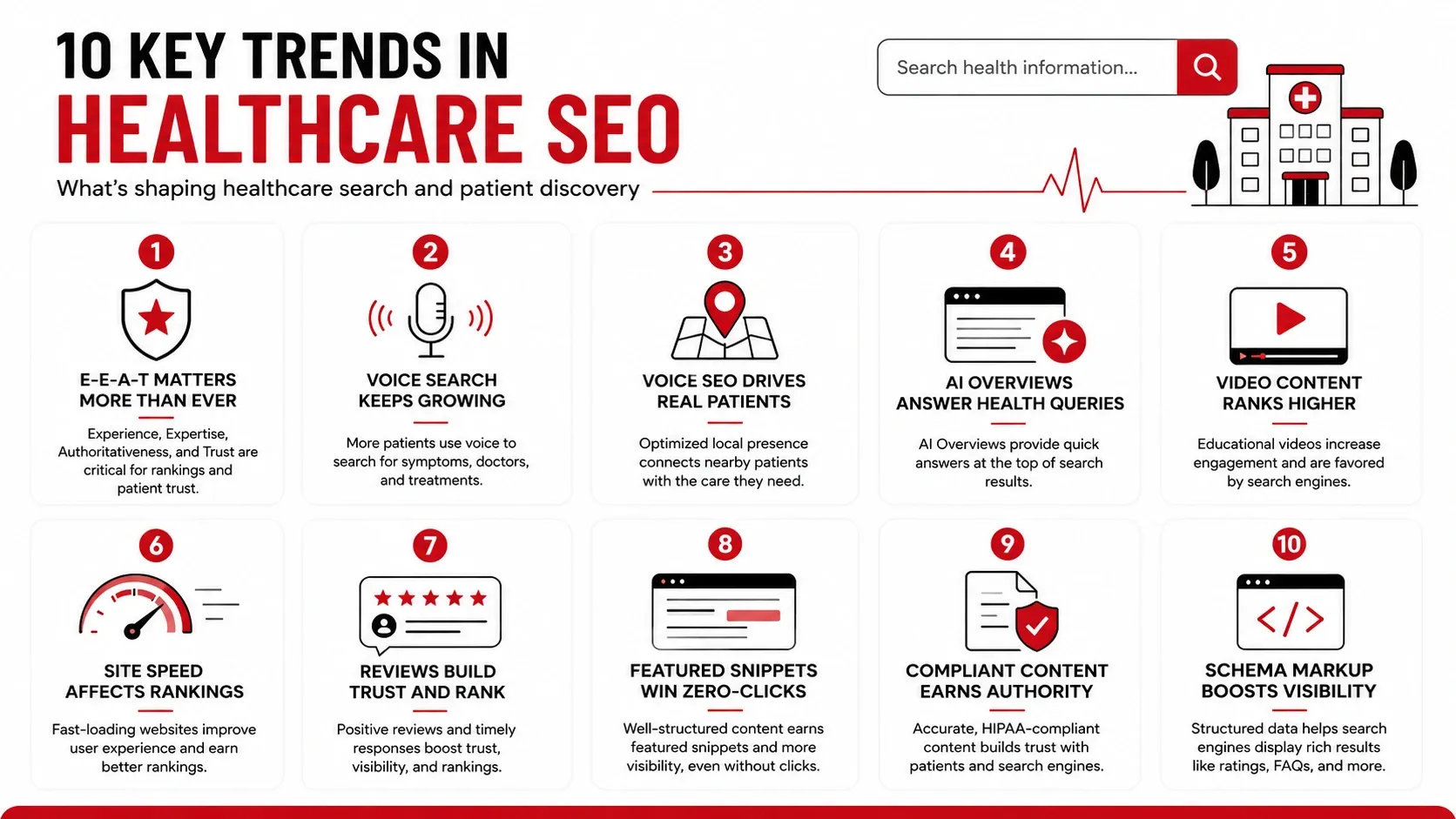
Key Trends in Healthcare SEO in Recent Years
Healthcare seo for healthcare industry professionals has shifted fast in the past few years. Ten trends now shape whether a clinic gets found or gets buried.
- E-E-A-T matters more than ever. Google rewards pages with visible expertise, real author credentials, and clear trust signals over generic, unattributed content.
- Voice search keeps growing. Industry data suggests a rising share of patients now use voice assistants to find urgent care, pharmacies, and specialists nearby.
- Local SEO drives real patients. Near-me searches convert at high rates because they signal immediate, location-specific intent.
- AI Overviews answer health queries. Research consistently shows AI-generated answer boxes now appear across a meaningful share of health-related searches, pulling traffic away from standard listings.
- Video content ranks higher. Patient education videos increase engagement and give search engines more context about page relevance.
- Site speed affects rankings. Slow pages lose both patients and ranking position, especially on mobile devices, which is why Website Design for Healthcare is now a ranking factor, not just an aesthetic choice.
- Reviews build trust and rank. Seo healthcare providers with consistent, recent reviews outperform competitors with outdated or sparse review profiles.
- Featured snippets win zero-clicks. Well-structured answers capture visibility even when a patient never clicks through to the site.
- Compliant content earns authority. Health care seo services that prioritize accuracy and privacy build long-term trust that generic content can't replicate.
- Schema markup boosts visibility. Structured data increases the odds of rich results, from star ratings to FAQ dropdowns, directly in search.
These ten shifts point to one conclusion: seo medical strategy is no longer optional polish; it's core infrastructure for patient acquisition.
Advantages of Investing in Healthcare SEO
Investing in SEO for healthcare pays back in ways paid ads never do. Once a page ranks, it keeps generating patient inquiries without ongoing spend per click. Instead of relying on a marketing budget that disappears every month, healthcare organizations can build a sustainable online presence that attracts patients consistently. Over time, SEO becomes a valuable long-term asset that supports growth, strengthens credibility, and increases visibility across search engines.
- Boosts visibility for patient searches. Targeted Keyword Research puts a clinic in front of patients at the exact moment they're searching for care. Appearing on the first page increases the likelihood of attracting qualified visitors who are actively seeking medical services.
- Builds long-term trust. Consistent, accurate content establishes a clinic as a credible authority, not just another search result. Educational resources and expert insights reassure patients before they even schedule an appointment.
- Cuts paid ad spend. Organic rankings reduce dependence on pay-per-click campaigns that stop producing results the moment budgets shrink. This allows marketing budgets to be allocated more strategically.
- Attracts more local patients. Strong local SEO signals connect nearby patients with providers who can actually serve them. Optimized local listings improve visibility for "near me" and location-based searches.
- Lowers patient acquisition costs. Industry data suggests organic channels cost meaningfully less per acquired patient than paid alternatives over time. As rankings improve, the return on investment continues to increase.
Organic growth compounds. A well-optimized page keeps attracting patients months and years after it's published, unlike an ad that stops the second spending stops. Every new piece of optimized content expands your digital footprint and creates additional opportunities to reach potential patients.
- Strengthens brand authority. Ranking consistently for relevant terms positions a healthcare brand as a recognized name in its specialty. Repeated visibility helps build familiarity and confidence among prospective patients.
- Drives compounding organic traffic. Each new optimized page adds to a growing base of visibility that keeps building on itself. As your website expands, search engines gain more reasons to recommend it.
- Improves website experience. Implementing SEO best practices inherently enhances site speed, mobile usability, and navigation, which in turn benefits all visitors. A better user experience also encourages patients to stay longer and explore more services.
- Increases qualified conversions. Patients who arrive through relevant search terms are already closer to booking than cold traffic because they have demonstrated clear intent.
- Delivers measurable ROI. Clear tracking through rankings, traffic, and conversions makes SEO one of the most measurable investments a clinic can make. Regular reporting also helps identify new growth opportunities and refine long-term marketing strategies.
Ten advantages, one outcome: a clinic that shows up consistently earns patients that competitors never get the chance to reach while building lasting online visibility and sustainable business growth.
Best SEO Automation Tools for the Healthcare Industry
Manual SEO doesn't scale across dozens of location pages, service pages, and blog posts. The right tools handle repetitive tracking so teams can focus on strategy.
-
- Ahrefs or Semrush track keyword rankings, backlink profiles, and competitor movement in one dashboard, making it easier to spot opportunities before competitors do.
- Google Search Console shows exactly which queries bring patients to a site and flags indexing issues before they hurt visibility.
- Screaming Frog crawls an entire website to catch broken links, missing metadata, and technical errors that quietly drag down rankings.
- Surfer SEO or Clearscope analyze top-ranking pages for a given search term and guide content structure to match what's already working.
- Schema markup generators simplify adding structured data for clinics, physicians, and FAQs without needing to hand-code every field.
- PageSpeed Insights measures site speed and mobile performance, a core part of Technical SEO that directly influences rankings and patient experience.
Automation doesn't replace strategy. It removes the manual grind so a healthcare team can spend time on decisions, not data entry.
-
- Ahrefs / Semrush: rankings and competitor tracking
- Google Search Console: query and indexing insights
- Screaming Frog: technical site audits
- Surfer SEO / Clearscope: content optimization
- Schema generators: structured data automation
- PageSpeed Insights: speed and performance monitoring
How Much Should You Spend on SEO?
SEO spend for healthcare providers typically depends on competition, location, and current site condition, but most clinics invest a consistent monthly budget rather than a single lump sum. Small practices often start smaller and scale up, while multi-location healthcare groups need larger, ongoing investment to compete across every market they serve.
Cost varies because healthcare seo isn't a flat-rate service. A single-location clinic in a smaller market needs less investment than a multi-specialty group competing in a major city.
What typically drives cost:
- Number of locations. Each additional location adds pages, listings, and local optimization work.
- Competition level. Crowded specialties like dermatology or dentistry require more sustained investment to outrank established competitors.
- Current site health. A site with major technical issues needs upfront audit and fix work before growth strategies pay off.
- Content volume needed. Practices with thin or outdated content need more investment in content creation early on.
How Can You Control the Cost of SEO in the Healthcare Industry?
Controlling SEO costs in healthcare comes down to prioritizing high-impact work first, avoiding redundant tools, and choosing a provider who scopes work around actual goals instead of generic packages. Clinics that plan strategically spend less over time than those that chase every trend simultaneously.
Cost control isn't about spending less. It's about spending correctly, on the right priorities in the right order.
Practical ways to manage cost:
- Start with an audit. Fixing foundational issues first prevents wasted spend on content or links that a broken site can't fully benefit from.
- Prioritize high-intent pages first. Treatment and service pages typically convert faster than broad blog content, making them a smarter early investment.
- Avoid tool duplication. Consolidating platforms, including Off-page SEO trackers, instead of running five overlapping subscriptions, frees up budget for actual execution.
- Choose scoped engagements. A provider offering tailored healthcare SEO services for specific goals prevents paying for generic, unused deliverables.
- Review results quarterly. Regular check-ins catch underperforming strategies early, before budget gets wasted on tactics that aren't working.
Cost control works best as an ongoing discipline, not a one-time negotiation at the start of a contract.
Why Choose Upclues for Your Healthcare Centre?
Upclues builds SEO for healthcare that patients trust and search engines rank. From technical fixes to compliant content, every strategy is built around real patient search behavior, not generic templates.
The team combines branding, UI/UX, healthcare seo strategy, and Generative Engine Optimization under one roof, so websites don't just rank; they convert visitors into booked patients. Every recommendation ties back to measurable outcomes: more visibility, more qualified leads, more patients through the door.
Clinics don't need another agency running disconnected tactics. They need one partner managing the full picture, from audit to execution.
Take the Next Step
A clinic that ranks earns patients a competitor never gets the chance to reach. Every month without a healthcare seo strategy is a month of patients choosing someone else first.
Ready to see where your website stands? Book a free healthcare SEO audit with Upclues and find out exactly what's holding your rankings back.
Final Thoughts
Healthcare SEO isn't a marketing add-on anymore. It's the front door most patients walk through before they ever set foot in a clinic.
The providers who invest in visibility, trust, and structured content are the ones patients find first and choose first. SEO for healthcare rewards clinics that stay consistent over months, not those chasing quick wins that fade.
The eight pillars, sixteen strategies, and ten trends covered here all point to the same truth: patients are searching right now. The only question is whether your clinic shows up when they do.
Frequently Asked Questions
1. What is healthcare SEO?
Healthcare SEO is the process of optimizing a medical website to rank higher for patient searches while meeting strict accuracy, compliance, and trust standards unique to medical content.
2. How long does healthcare SEO take to show results?
Most clinics see meaningful ranking improvements within three to six months, with stronger compounding results appearing after eight to twelve months of consistent execution.
3. Is healthcare SEO different from regular SEO?
Yes. Healthcare SEO requires stricter accuracy, HIPAA-aware design, and E-E-A-T signals since Google treats medical pages as YMYL content affecting patient safety and trust.
4. Do small clinics need SEO, or just large hospital groups?
Small clinics benefit just as much, often more, since local SEO directly connects them with nearby patients actively searching for care right now.
5. What's the biggest mistake clinics make with SEO?
Approaching SEO as a singular project rather than a continuous strategy. Rankings built over months can erode quickly without regular audits and updates.
6. Can AI Overviews affect a clinic's website traffic?
Yes. AI-generated answer boxes now capture visibility for many health searches, making structured, GEO-optimized content essential for staying visible in results.
7. How do I know if my healthcare SEO strategy is working?
Track keyword rankings, organic traffic, and patient inquiry volume monthly. Consistent upward movement across all three signals a strategy that's working.
Ready to refresh your brand?
Contact Upclues today and start your branding journey.