



Complete SEO for Cosmetic Dentists: Local Rankings, Trust Signals & Patient Conversions
June 11, 2026
What Strategies Improve Brand Visibility in AI Search Engines? A Complete Guide for 2026
June 25, 2026Complete SEO for Cosmetic Dentists: Local Rankings, Trust Signals & Patient Conversions
June 11, 2026What Strategies Improve Brand Visibility in AI Search Engines? A Complete Guide for 2026
June 25, 2026Top Proven Benefits of SEO for Oral Surgeons Looking to Expand Their Practice
June 22, 2026
- 15 min to Read
Quick Read
- Over 70% of patients now search online for specialists before calling, making local SEO critical for capturing high-intent referrals.
- SEO for oral surgeons drives qualified, ready-to-book patient leads at a fraction of the cost of paid advertising.
- Unlike referral networks, SEO builds lasting online authority that compounds over time and attracts patients across your entire service area.
- Proper keyword optimization, local citations, and patient-focused content position your practice as the trusted specialist choice in your region.
Introduction
For oral surgeons and maxillofacial specialists, growth has traditionally relied on referrals and reputation. But with over 70% of patients searching online for oral surgery services before contacting a practice, practices that lack search visibility risk losing qualified leads to competitors.
SEO for oral surgeons optimizes your website, content, and online presence so that patients searching for procedures such as wisdom tooth extraction, dental implants, or corrective jaw surgery find your practice first. It helps attract ready-to-book patients while building local authority and trust.
This guide explains why SEO matters, how it works, and the business benefits it delivers for practices looking to grow beyond referrals and strengthen their regional presence.
What Does SEO Mean for Oral Surgeons in Layman's Terms?
SEO for oral surgeons is the practice of optimizing your website, content, and online profiles so patients searching for procedures - like extractions, implants, or jaw surgery - find your practice in Google search results. It involves keyword research, website optimization, local citations, and patient-focused content that builds trust and drives qualified leads.
At its core, SEO for oral surgeons means making your practice visible when patients search for the services you offer. When someone in your area types "wisdom tooth removal near me" or "emergency oral surgeon," they're looking for you. Without SEO, they'll find your competitors instead.
SEO isn't about tricking Google. It's about proving to search engines that your practice is trustworthy, experienced, and relevant to what patients are searching for. Google's algorithm prioritizes practices that demonstrate expertise, strong patient reviews, and high-quality, original content about oral surgery procedures.
How SEO Fits into a Modern Oral Surgery Marketing Strategy?
Your marketing strategy needs multiple channels. Referrals are valuable but passive. SEO is active - it puts your practice in front of patients already searching for solutions. While referrals bring patients through your network, SEO brings patients who are actively looking for exactly what you offer and scales in ways referrals alone never can.
SEO also strengthens your referral ecosystem. General dentists increasingly search for specialists online. Just as SEO for dentists helps general practices stay competitive, SEO for oral surgeons builds visibility that referring dentists trust and find easily. When dentists search "oral surgeon in [city]," your practice ranks first. This strengthens referral partnerships while supporting your entire digital strategy through improved visibility, better patient experience, and stronger authority.
Common Myths About SEO for Oral Surgeons
Myth 1: "We get all our patients from referrals, so we don't need SEO."
Referrals are valuable, but they're limited by your network size. Meanwhile, your competitors are capturing patients online. Over time, practices that invest in SEO grow faster and more sustainably than those relying on referrals alone.
Myth 2: "SEO takes too long to work."
Search Engine Optimization (SEO) requires time - usually between 3 to 6 months - to yield noticeable results. In contrast, paid advertisements cease to be effective as soon as the funding stops. SEO builds upon itself. A patient who discovers your services through a search today remains accessible for many years to come.
Myth 3: "Competing with national dental chains online is beyond our capabilities."
Local SEO levels the playing field. National chains rank for broad searches, but local SEO helps you own "emergency oral surgeon in [your city]" - exactly where your patients are looking.
Ready to refresh your brand?
Contact Upclues today and start your branding journey.
Why Does SEO for Oral Surgeons and Maxillofacial Practices Matter?
The stakes are high for oral surgery practices. Patient acquisition determines growth, and patient acquisition happens online first. Without SEO, you're invisible to the exact patients searching for your services right now. Let's explore why SEO isn't optional for modern surgical practices.
Changing Patient Behavior: Why "Near Me" Searches Are Critical
Patients now search "near me" to find specialists. Over 70% of patient journeys begin with an online search. If your practice doesn't rank for local searches, patients book appointments with competitors. Local SEO ensures you capture these high-intent, ready-to-book patients before they contact anyone else.
The shift is real and measurable. Patients don't flip through phone books anymore. They type "emergency oral surgeon near me" or "maxillofacial surgeon [city]" into Google, and they call the top result. Your practice either shows up, or it doesn't.
Local search is especially critical for oral surgery because patients often need urgent care. They want the closest qualified specialist, now. If you're not visible in local search results, they'll find someone who is - even if they've never heard of your competitors before.
Why Oral Surgeons Cannot Rely Only on Referrals Anymore
Referrals are passive. They depend on who happens to know your name. Meanwhile, your market is growing. New patients move into your area every day, and they're searching for you online - not calling someone they might know.
Referral networks also have a ceiling. Once you've exhausted your referring dentists' patient pools, growth stalls. SEO doesn't have that limit. It taps into the entire market of patients actively searching for your services in your region.
“Studies show that referral-dependent practices grow 15-25% annually, while practices with strong SEO grow 30-50% annually over three to five years.”
How SEO for Oral Surgeons Increases Case Quality and Volume
Not all leads are equal. SEO attracts patients who are actively searching for your procedures - wisdom tooth extractions, implants, corrective jaw surgery, and reconstruction. These are high-intent leads. They're ready to book. Conversion rates are higher because intent is already there.
Paid ads attract clicks. SEO attracts qualified intent. A patient searching "wisdom tooth extraction cost [city]" is further along in their decision-making process than someone who sees a random ad. They're comparing options and ready to commit.
Role of SEO in Building a Trusted Specialist Brand
Your website is your credibility hub. When patients find you through a search, they see your expertise displayed: before-and-after galleries, patient testimonials, detailed procedure explanations, and credentials. Google's algorithm rewards this depth with higher rankings.
Over time, consistent visibility builds regional authority. Patients see your name repeatedly in search results, Google Business Profile, local directories, and news mentions. Authority compounds - more visibility leads to more reviews, which leads to more visibility.
Key Benefits of SEO for Oral Surgeons and Maxillofacial Practices
SEO is more than a strategy for improving rankings-it's a long-term growth engine that helps oral surgery practices attract qualified patients, build credibility, and increase revenue. As more patients turn to Google to research symptoms, procedures, and providers, a strong SEO presence ensures your practice remains visible at every stage of the patient journey.
Visibility for Oral Surgery
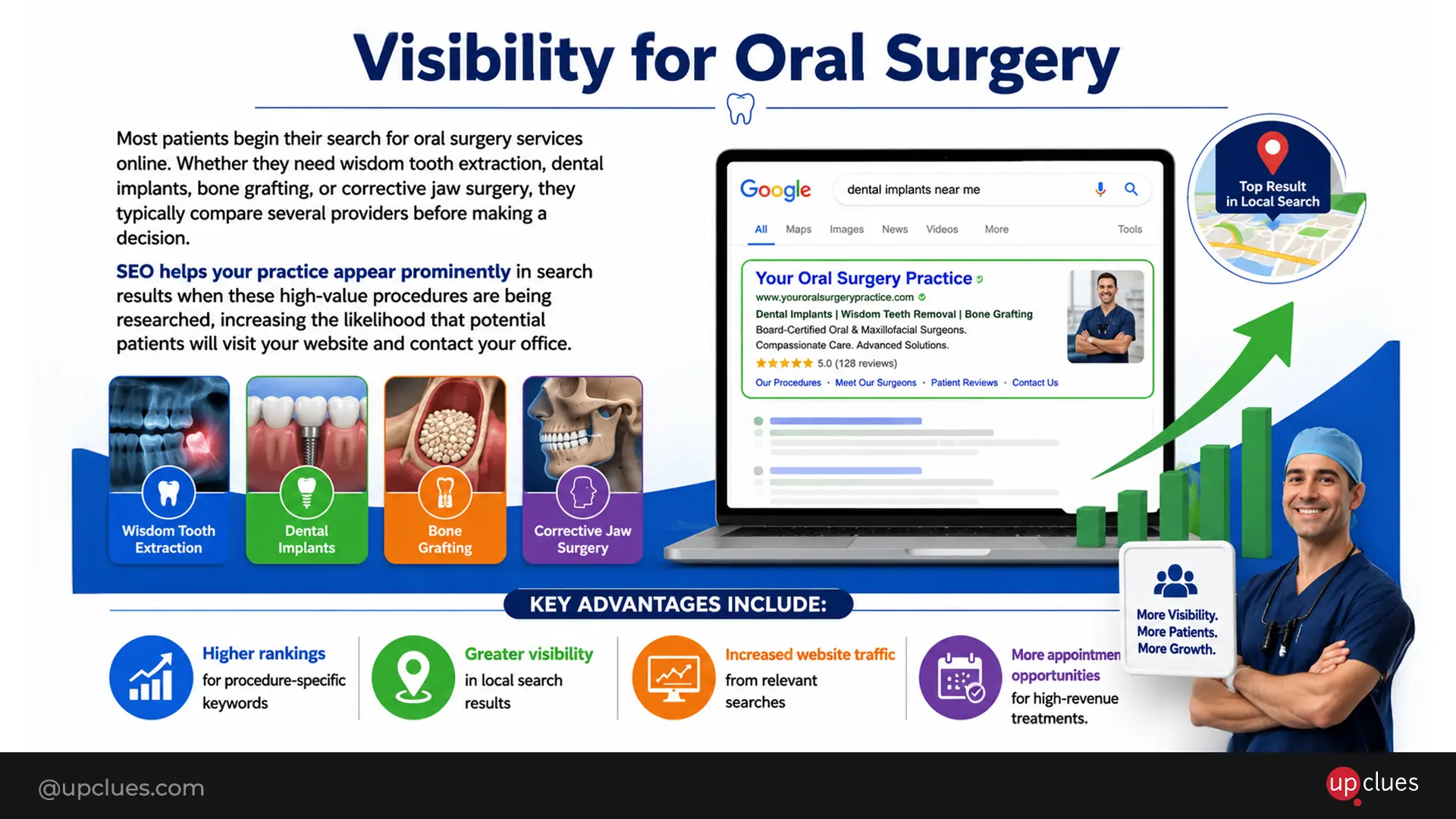
Most patients begin their search for oral surgery services online. Whether they need wisdom tooth extraction, dental implants, bone grafting, or corrective jaw surgery, they typically compare several providers before making a decision. SEO helps your practice appear prominently in search results when these high-value procedures are being researched, increasing the likelihood that potential patients will visit your website and contact your office.
Key advantages include:
- Higher rankings for procedure-specific keywords
- Greater visibility in local search results
- Increased website traffic from relevant searches
- More appointment opportunities for high-revenue treatments
Targeted Patient Traffic
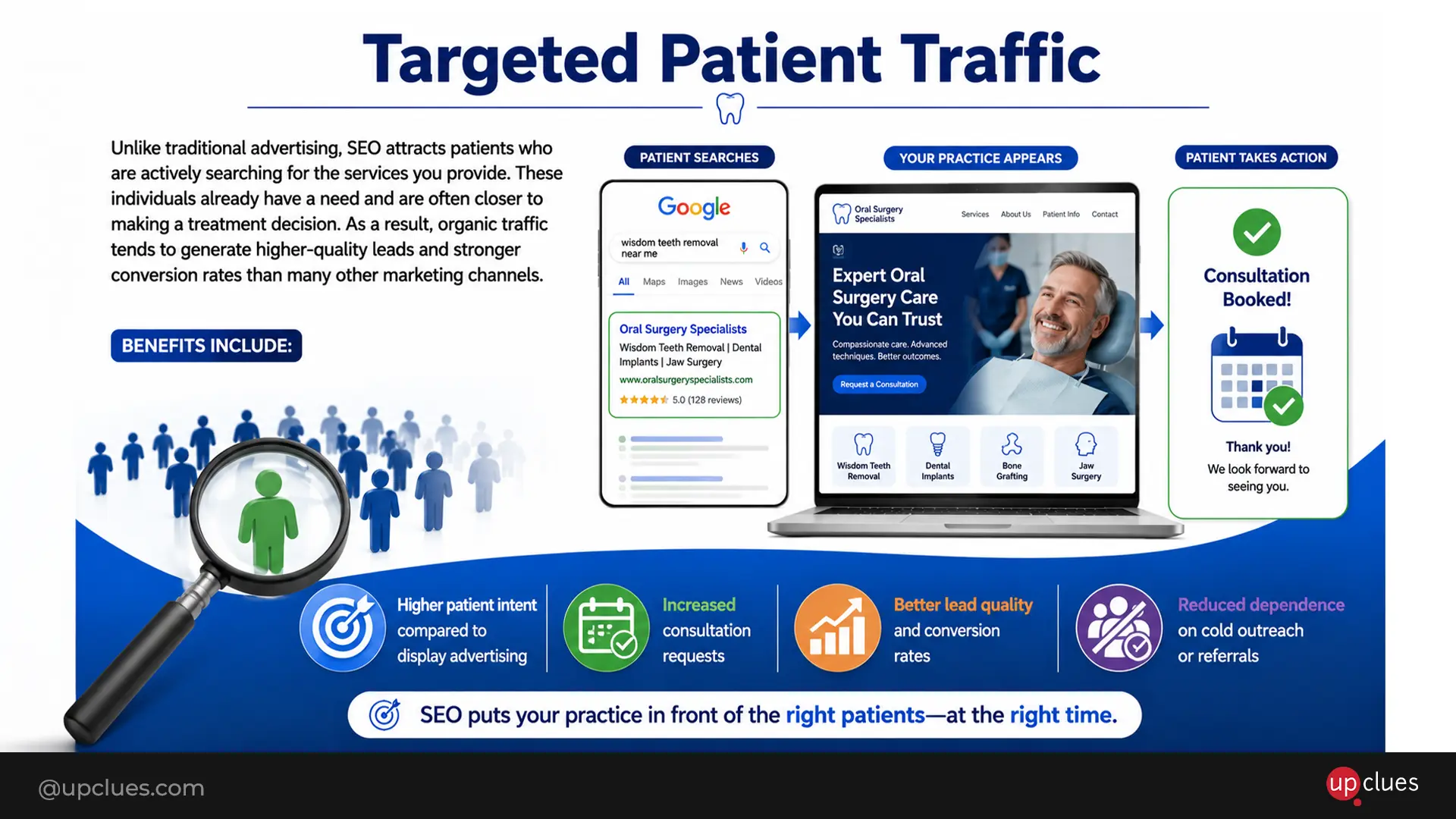
Unlike traditional advertising, SEO attracts patients who are actively searching for the services you provide. These individuals already have a need and are often closer to making a treatment decision. As a result, organic traffic tends to generate higher-quality leads and stronger conversion rates than many other marketing channels.
Benefits include:
- Higher patient intent compared to display advertising
- Increased consultation requests
- Better lead quality and conversion rates
- Reduced dependence on cold outreach or referrals
Patient Trust & Credibility
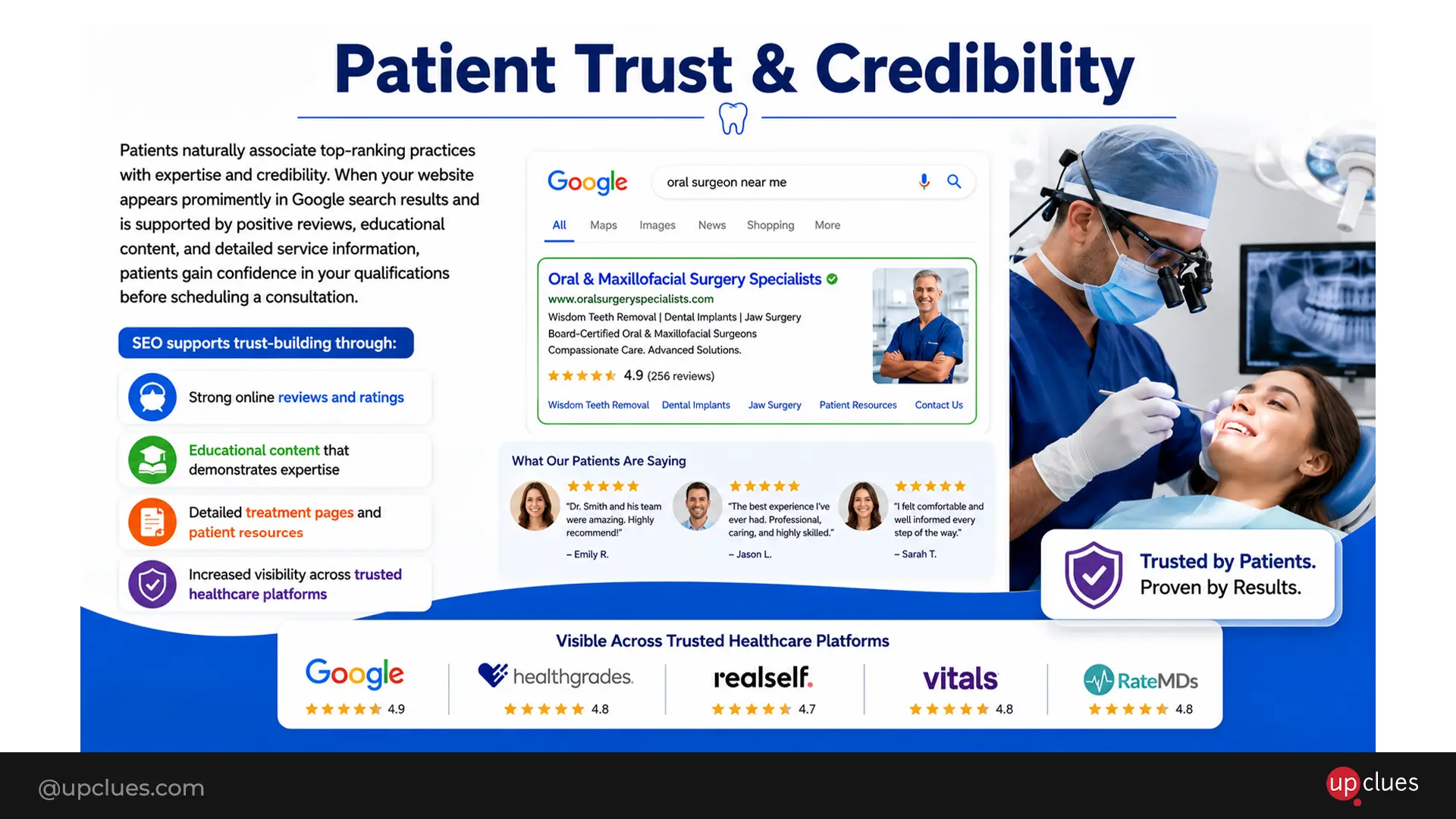
Patients naturally associate top-ranking practices with expertise and credibility. When your website appears prominently in Google search results and is supported by positive reviews, educational content, and detailed service information, patients gain confidence in your qualifications before scheduling a consultation.
SEO supports trust-building through:
- Strong online reviews and ratings
- Educational content that demonstrates expertise
- Detailed treatment pages and patient resources
- Increased visibility across trusted healthcare platforms
Scalable Marketing Growth
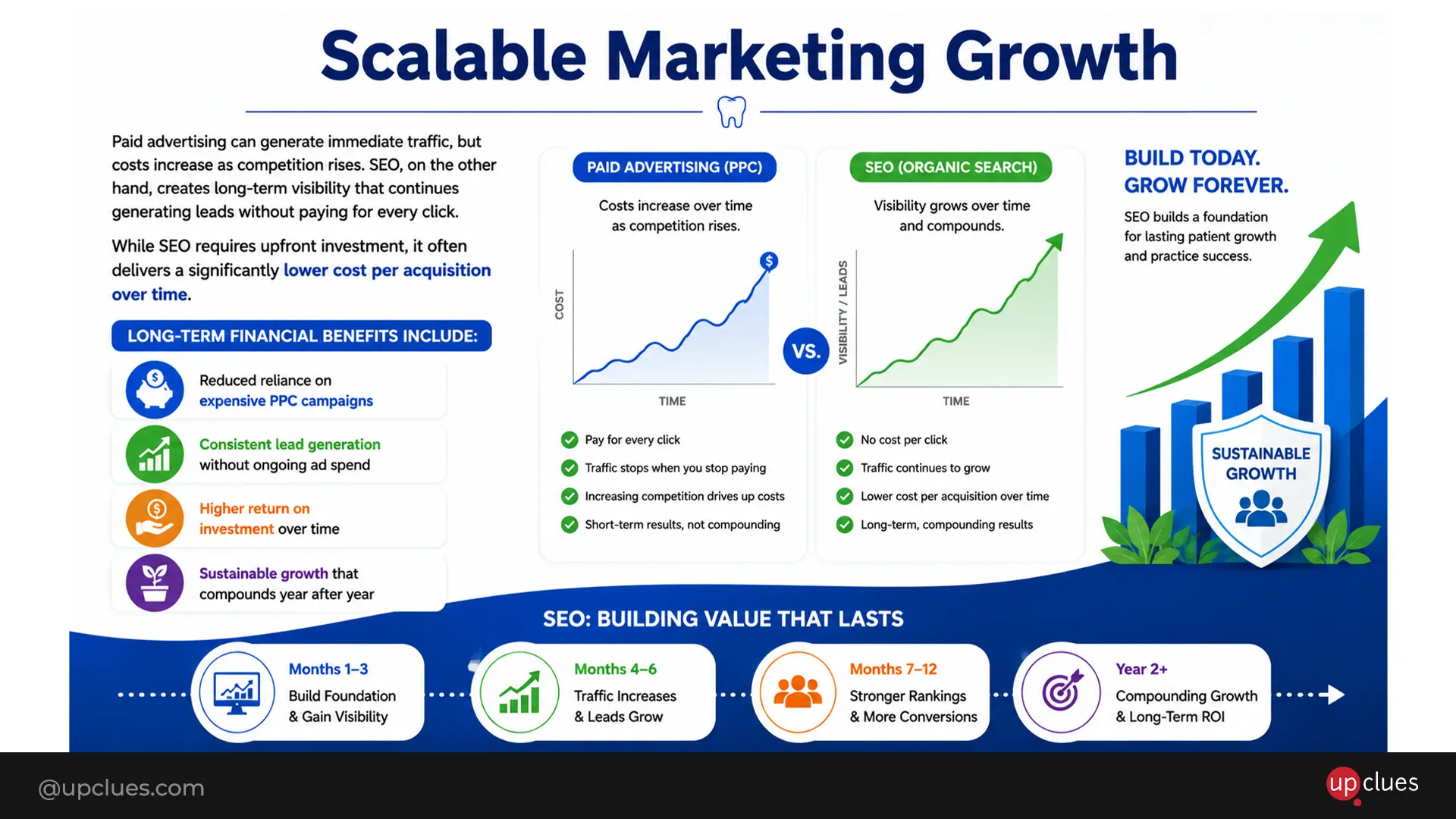
Paid advertising can generate immediate traffic, but costs increase as competition rises. SEO, on the other hand, creates long-term visibility that continues generating leads without paying for every click. While SEO requires upfront investment, it often delivers a significantly lower cost per acquisition over time.
Long-term financial benefits include:
- Reduced reliance on expensive PPC campaigns
- Consistent lead generation without ongoing ad spend
- Higher return on investment over time
- Sustainable growth that compounds year after year
Better Website Conversions
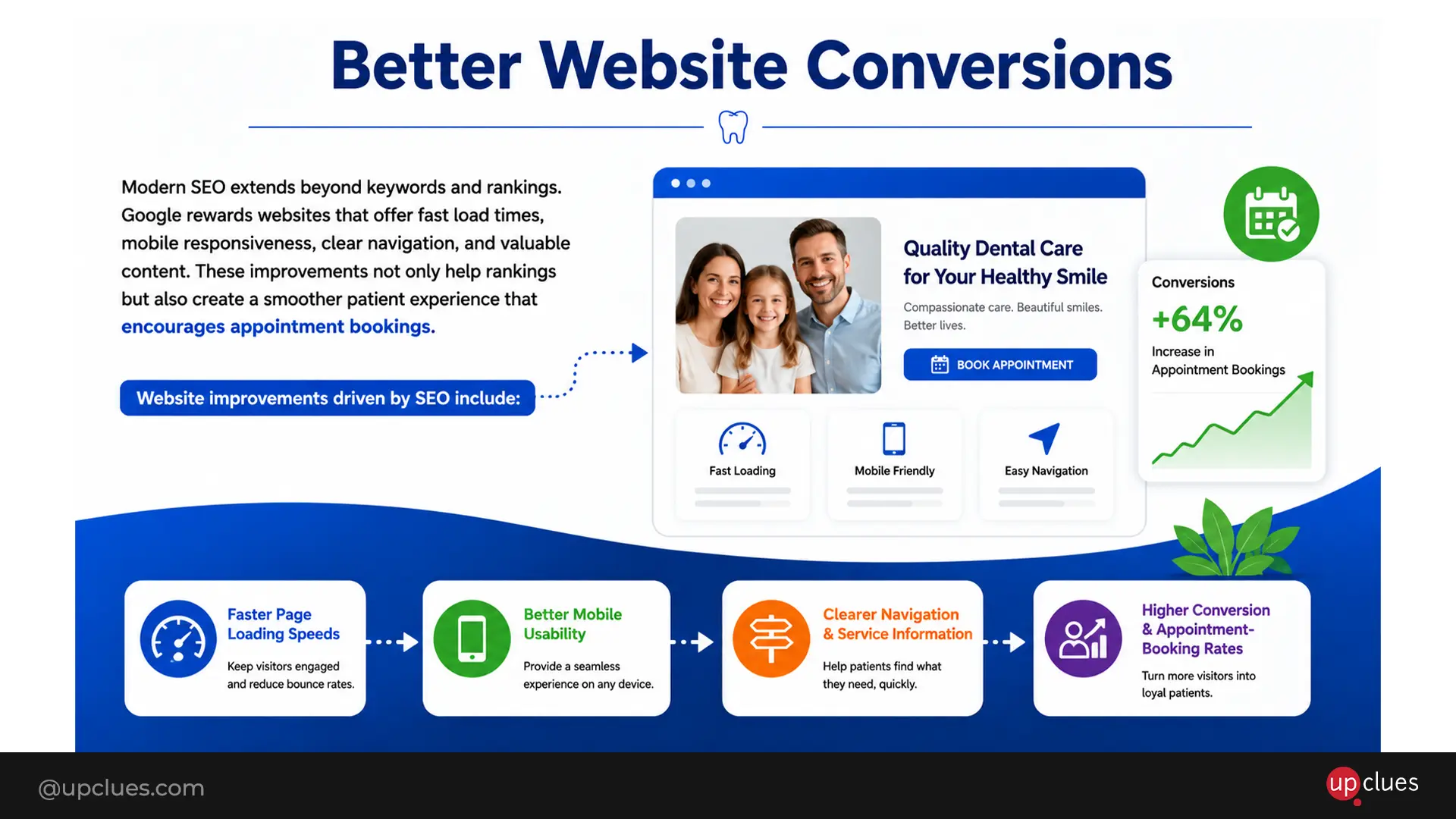
Modern SEO extends beyond keywords and rankings. Google rewards websites that offer fast load times, mobile responsiveness, clear navigation, and valuable content. These improvements not only help rankings but also create a smoother patient experience that encourages appointment bookings.
Website improvements driven by SEO include:
- Faster page loading speeds
- Better mobile usability
- Clearer navigation and service information
- Higher conversion and appointment-booking rates
Local Patient Acquisition
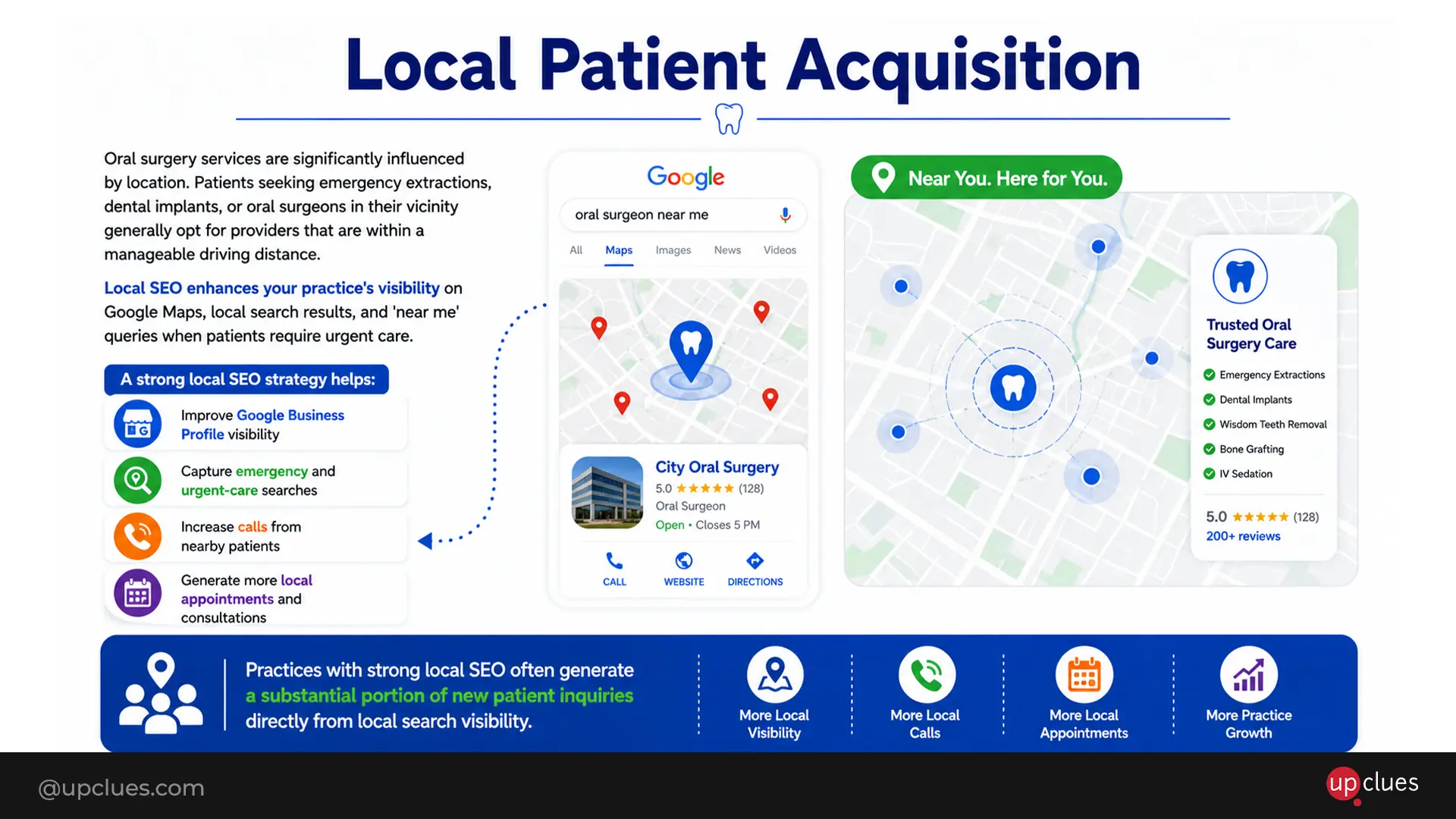
Oral surgery services are significantly influenced by location. Patients seeking emergency extractions, dental implants, or oral surgeons in their vicinity generally opt for providers that are within a manageable driving distance. Local SEO enhances your practice's visibility on Google Maps, local search results, and 'near me' queries when patients require urgent care.
A strong local SEO strategy helps:
- Improve Google Business Profile visibility
- Capture emergency and urgent-care searches
- Increase calls from nearby patients
- Generate more local appointments and consultations
Practices with strong local SEO often generate a substantial portion of new patient inquiries directly from local search visibility.
Competitive Market Advantage
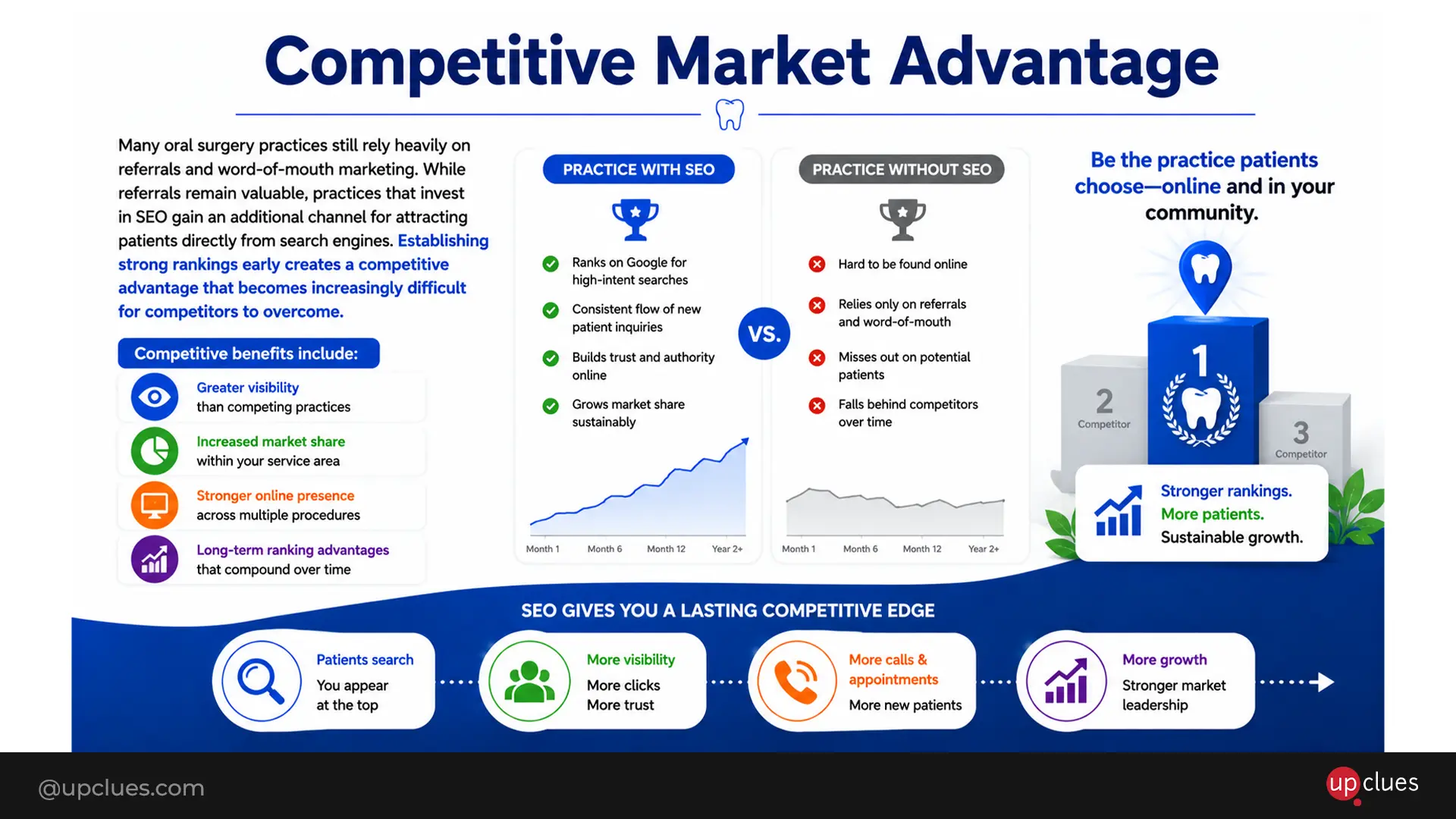
Many oral surgery practices still rely heavily on referrals and word-of-mouth marketing. While referrals remain valuable, practices that invest in SEO gain an additional channel for attracting patients directly from search engines. Establishing strong rankings early creates a competitive advantage that becomes increasingly difficult for competitors to overcome.
Competitive benefits include:
- Greater visibility than competing practices
- Increased market share within your service area
- Stronger online presence across multiple procedures
- Long-term ranking advantages that compound over time
Trackable SEO Performance
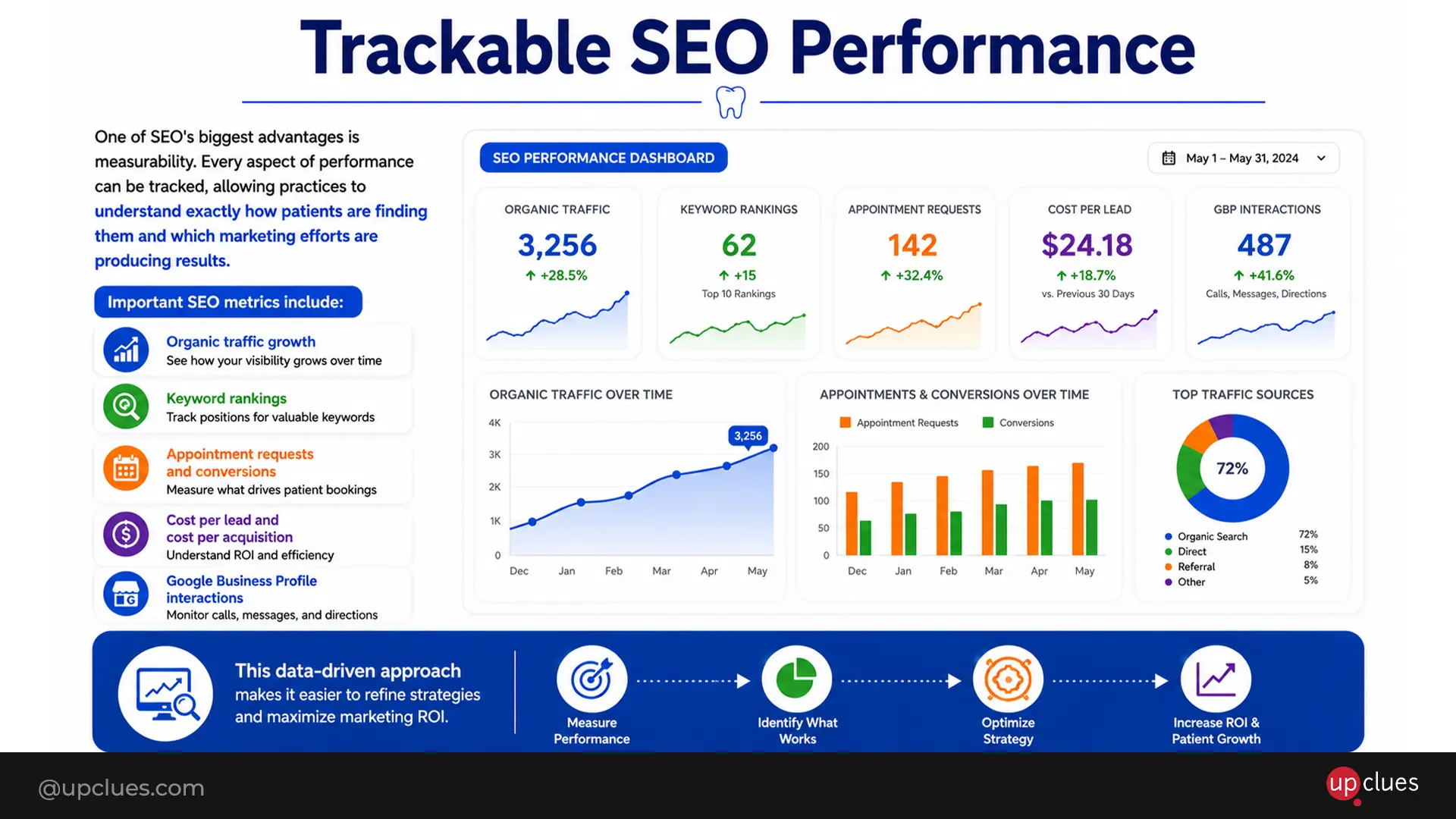
One of SEO's biggest advantages is measurability. Every aspect of performance can be tracked, allowing practices to understand exactly how patients are finding them and which marketing efforts are producing results.
Important SEO metrics include:
- Organic traffic growth
- Keyword rankings
- Appointment requests and conversions
- Cost per lead and cost per acquisition
- Google Business Profile interactions
This data-driven approach makes it easier to refine strategies and maximize marketing ROI.
Regional Brand Authority
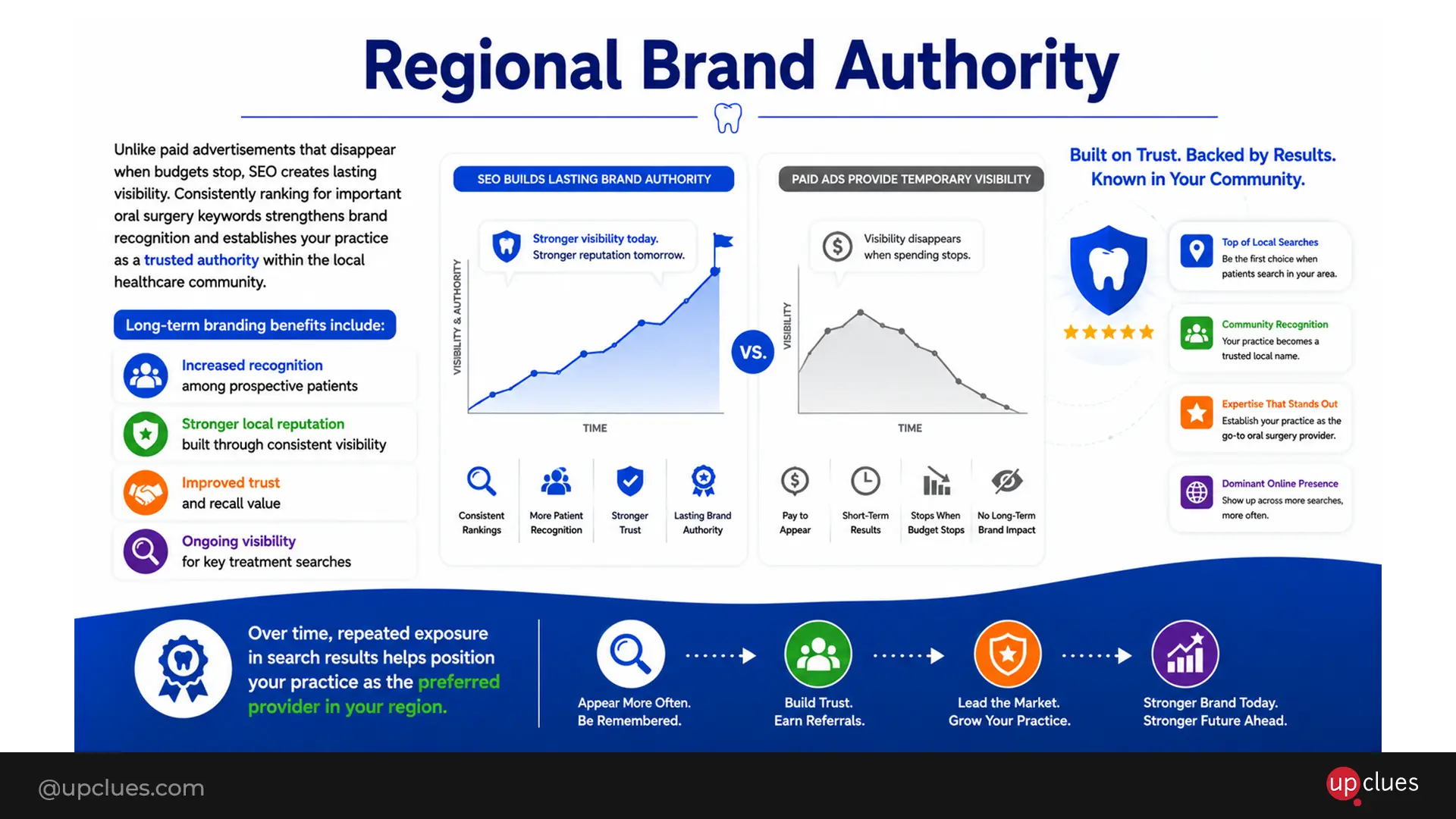
Unlike paid advertisements that disappear when budgets stop, SEO creates lasting visibility. Consistently ranking for important oral surgery keywords strengthens brand recognition and establishes your practice as a trusted authority within the local healthcare community.
Long-term branding benefits include:
- Increased recognition among prospective patients
- Stronger local reputation
- Improved trust and recall value
- Ongoing visibility for key treatment searches
Over time, repeated exposure in search results helps position your practice as the preferred provider in your region.
Patient Journey Alignment
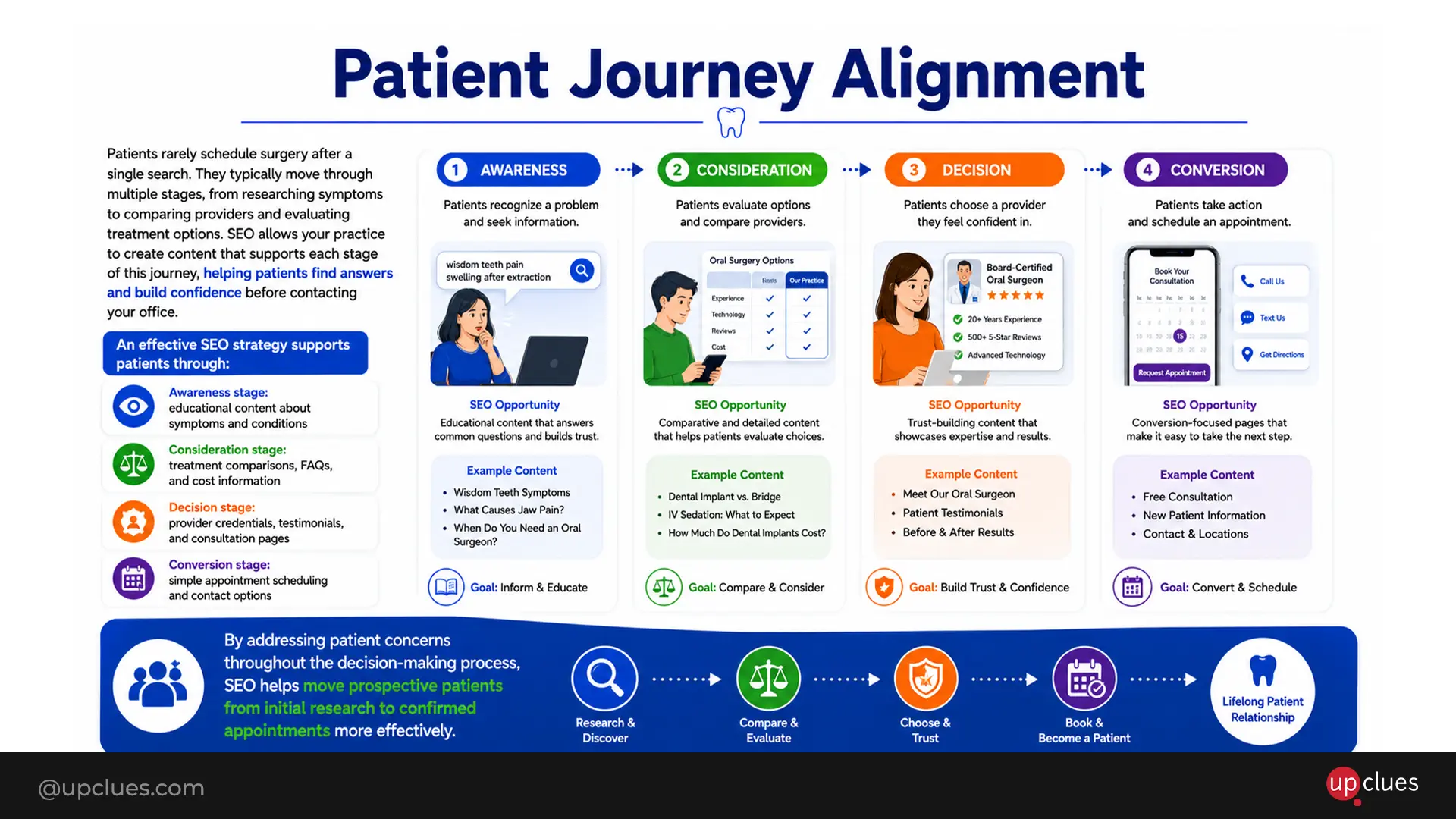
Patients rarely schedule surgery after a single search. They typically move through multiple stages, from researching symptoms to comparing providers and evaluating treatment options. SEO allows your practice to create content that supports each stage of this journey, helping patients find answers and build confidence before contacting your office.
An effective SEO strategy supports patients through:
- Awareness stage: educational content about symptoms and conditions
- Consideration stage: treatment comparisons, FAQs, and cost information
- Decision stage: provider credentials, testimonials, and consultation pages
- Conversion stage: simple appointment scheduling and contact options
By addressing patient concerns throughout the decision-making process, SEO helps move prospective patients from initial research to confirmed appointments more effectively.
How to Do Keyword Optimization for Oral Surgeons
Keyword optimization serves as the cornerstone of SEO. It is essential to focus on the appropriate search terms - those that patients genuinely utilize when seeking your services. This section outlines a pragmatic method for identifying, organizing, and implementing keywords throughout your website and content.
Begin with Understanding Patient Search Intent for Oral Surgery Services
Ask yourself: What are patients actually searching for when they need oral surgery? Not industry jargon - real search queries.
Common high-intent searches include:
- "Emergency oral surgeon near me"
- "Wisdom tooth extraction cost [city]"
- "Dental implant specialist [city]"
- "Corrective jaw surgery [city]"
- "Oral surgeon for [specific procedure]"
These searches show intent. The patient has a problem and is looking for a solution. Your keyword strategy must target these intent-driven queries, not just your service names.
Perform Targeted Keyword Research for Oral and Maxillofacial Procedures
Utilize tools such as SEMrush, Ahrefs, or Google Keyword Planner to pinpoint:
- Primary keywords: "Oral surgeon [city]," "maxillofacial surgeon [city]."
- Procedure keywords: "Wisdom tooth removal," "dental implants," "corrective jaw surgery"
- Local variations: "[Procedure] near me," "[Procedure] in [city]"
- Question-based keywords: "What is the cost of [procedure]," "What should I expect after [procedure]."
“Oral surgeons who target location-specific keywords see 3x higher conversion rates than those targeting generic national keywords.”
Map Keywords to Specific Service, Location, and FAQ Pages
Create a simple spreadsheet:
- Column 1: Keyword + search volume
- Column 2: Funnel stage (TOFU/MOFU/BOFU)
- Column 3: Best page for this keyword (service page, FAQ, blog post)
Example: "Emergency oral surgeon [city]" → BOFU → Google Business Profile + service page. "What to expect after wisdom tooth extraction" → TOFU → blog post.
Each page should target 1-2 primary keywords and 3-4 secondary keywords. Over-optimization is a red flag to Google.
Optimize On-Page Elements (Titles, Meta, Headers, Content)
Place your primary keyword naturally in:
- H1 (once per page)
- Meta title (under 60 characters)
- Meta description (150-160 characters, includes keyword naturally)
- At least one H2
- First 100 words of content
Use secondary keywords in other H2s and H3s. Sprinkle semantic keywords throughout, but never force them. Natural readability always wins.
Use Local SEO Keywords Strategically for City and "Near Me" Searches
Local SEO for oral surgery practices means optimizing for geographic modifiers. Update your:
- Google Business Profile that includes comprehensive information, images, and detailed procedure lists.
- Local citations (NAP consistency: Name, Address, Phone)
- Service area pages targeting nearby cities and suburbs
- FAQ schema with location-specific answers
Example: "Do you offer emergency extractions? Yes, we serve [city], [city], and [city]."
How Does SEO for Oral Surgeons Work Step by Step?
SEO isn't magic - it's a systematic process. Google ranks websites based on technical quality, content relevance, authority, and user trust. Here's how each component works together to build a rankings-winning strategy for oral surgeons.
On-Page SEO: Structuring Your Oral Surgery Website for Search
On-page SEO involves enhancing the content and HTML components of every page. This is where the positioning of keywords, the structure, and the ease of reading are of utmost importance.
Title Tags & Meta Descriptions:
Every page needs a unique title tag (under 60 characters) and a meta description (150-160 characters). For a wisdom tooth extraction service page: "Wisdom Tooth Extraction in [City] | Experienced Oral Surgeon." Include your primary keyword once, naturally.
Header Structure (H1, H2, H3):
Utilize a single H1 tag for each page, as it represents the primary subject of your content. Organize the information using H2 and H3 tags that incorporate secondary and semantic keywords. For instance, consider the following structure:
- H1: "Wisdom Tooth Extraction [City]"
- H2: "What Is Wisdom Tooth Extraction?"
- H2: "Why You Might Need Wisdom Tooth Removal"
- H3: "Impacted Wisdom Teeth"
- H3: "Overcrowding and Orthodontic Reasons"
- H2: "What to Expect Before, During, and After"
Content Quality & Length:
Service pages should be 800-1,500 words. Blog posts 1,500-2,500 words. Depth matters to Google - pages that comprehensively answer patient questions rank higher. Don't pad with filler; every section should provide clear value.
Internal Linking Strategy:
Link related content using descriptive anchor text. Example: "Learn more about our [dental implant services]" links to your dental implant services page. This helps Google understand your website's structure and distribute ranking authority across its pages.
Off-Page SEO: Backlinks, Citations, and Online Reputation
Off-page SEO builds authority outside your website. Google regards links from external websites as endorsements of credibility. One link from a reputable medical directory or local publication is worth more than ten links from spam sites.
Backlinks:
Aim for quality over quantity. Links from:
- Local hospital or medical association websites
- Patient education platforms
- Local news coverage
- Industry partnerships
A natural backlink strategy for oral surgeons includes getting mentioned in local business directories, earning patient reviews, and contributing to professional medical publications.
Local Citations:
Citations are online references listing your practice's name, address, and phone number (NAP). Consistency is critical. Your NAP must be identical across:
- Google Business Profile
- Local directories (Yelp, Healthgrades, Zocdoc)
- Medical directories (Healthline, WebMD)
- Chamber of commerce listings
- Insurance provider networks
Patient Reviews & Reputation:
Google's algorithm heavily weighs patient reviews. Practices with 4.5+ star ratings rank higher than those with 3-star ratings. Encourage satisfied patients to leave reviews on Google, Yelp, and Healthgrades.
“Practices with 50+ local citations and 4.5+ star ratings see 2.5x higher click-through rates from search results compared to low-citation practices.”
Technical SEO: Site Speed, Mobile-Friendliness, and Security
Technical SEO ensures your website runs smoothly and Google can easily crawl and index it.
Page Speed:
Google prioritizes fast-loading pages. Patients abandon slow websites. Test your site speed with Google PageSpeed Insights. Target under 3 seconds for mobile, under 2 seconds for desktop. Optimize by:
- Compressing images
- Minifying code
- Enabling caching
- Using a Content Delivery Network (CDN)
Mobile-Friendliness:
Over 60% of searches happen on mobile. Your site must be fully responsive - readable and functional on phones and tablets. Google uses mobile-first indexing, meaning it crawls and ranks your mobile version first.
Site Security (HTTPS):
Google ranks HTTPS sites higher than HTTP. Install an SSL certificate so your URL shows "https://" and a padlock icon. This is non-negotiable for patient trust, especially in healthcare.
Crawlability & Indexing:
Submit your XML sitemap to Google Search Console. Ensure your robots.txt file doesn't block important pages. Fix broken links and redirect old URLs properly (301 redirects).
Content Strategy for Oral Surgeons: Blogs, FAQs, and Service Pages
Content is the engine of SEO. It answers patient questions, builds authority, and keeps visitors on your site longer.
Service Pages:
Each procedure (wisdom tooth extraction, implants, corrective jaw surgery) deserves a dedicated page that includes:
- What the procedure is and why it's needed
- Pre-operative preparation
- Step-by-step procedure overview
- Post-operative care and recovery timeline
- Before-and-after photos (when appropriate)
- FAQ section addressing common patient concerns
- Clear CTA (book consultation, request appointment)
Blog Posts:
Blog content targets informational search intent. Topics include:
- "How to Prepare for Wisdom Tooth Extraction"
- "Signs You Might Need Corrective Jaw Surgery"
- "What to Eat After Oral Surgery"
- "Complications of Untreated Impacted Teeth"
Blog posts are longer (1,500+ words), more detailed, and designed to build trust by educating patients.
FAQ Pages:
An FAQ page answers 8-12 common questions patients ask. Format it as Questions + Answers, making it easy for AI engines to extract direct answers. Examples:
- "How much does wisdom tooth extraction cost?"
- "Is oral surgery painful?"
- "How long is the recovery after implant surgery?"
Importance of Schema Markup and Medical/Local Structured Data
Schema markup tells Google what your content means. For oral surgeons, the most important types are:
LocalBusiness Schema:
Tell Google you're a local medical business. Include:
- Name, address, phone
- Service area (cities you serve)
- Hours of operation
- Profile image
MedicalBusiness / Physician Schema:
Indicates you're a qualified healthcare provider. Include:
- Credentials and specialties
- Board certifications
- Years of experience
FAQPage Schema:
Structure your FAQ section to optimize it for featured snippets and AI extraction. Each Q&A is marked up so Google knows it's a direct answer.
LocalService Schema (if applicable):
Shows you in Google Local Service Ads for emergency oral surgery.
Schema isn't visible to users - it's metadata that helps Google understand your site. Utilize tools such as Schema.org or Yoast SEO to create the appropriate markup.
How Google Evaluates E-E-A-T (Experience, Expertise, Authority, Trust) in Healthcare
E-E-A-T is Google's framework for ranking healthcare content. For oral surgeons, it means:
Experience:
Demonstrate hands-on experience with procedures. Include:
- Years in practice
- Number of procedures completed
- Specializations (implantology, orthognathic surgery, etc.)
- Hospital affiliations
Expertise:
Prove you know what you're talking about. Show:
- Educational background (DDS/DMD + specialty training)
- Peer-reviewed publications or speaking engagements
- Professional memberships (American Association of Oral and Maxillofacial Surgeons)
Authority:
Build reputation signals:
- Patient testimonials and case studies
- Media mentions and news coverage
- High-quality backlinks from authoritative sources
- Google Business Profile with reviews
Trust:
Make patients feel safe:
- Clear privacy policy
- Transparent pricing
- Patient testimonials and before-and-afters
- Professional, clean website design
- Easy-to-find contact and appointment information
“Google's E-E-A-T guidelines explicitly state that medical content from pages with higher author expertise, stronger credentials, and more patient reviews rank higher than generic content.”
When Should You Hire a Specialized SEO Agency for Oral Surgeons?
Not every practice needs to hire an agency immediately. If you have time to learn SEO, competitive keyword landscapes that are manageable, and patience for slower results, DIY is possible. However, most oral surgeons don't have the bandwidth. SEO requires ongoing keyword research, content creation, technical updates, and competitive monitoring - tasks that distract from patient care.
A specialized oral surgeon seo services agency brings expertise you can't easily replicate internally. They understand healthcare SEO rules, know how to build authority for surgical practices, and have tested strategies that work in competitive markets. They accelerate results from 6-12 months down to 3-4 months. They also stay current with Google algorithm updates, so your rankings don't crash after a core update.
Consider hiring an agency if: your market is competitive, you want results within 3-6 months, you lack in-house marketing staff, or you're losing patients to competitors ranking above you. Most oral surgery practices see ROI within 6-12 months of professional SEO work, making the investment worthwhile.
Final Thoughts on SEO for Oral Surgeons
Patient acquisition has changed. The oral surgery practices growing fastest aren't relying solely on referrals - they're ranking on Google, dominating local search, and building trust before patients make contact.
SEO for oral surgeons is now essential for sustainable growth. It helps generate qualified patient leads, strengthen regional authority, and increase long-term visibility. The strategy is straightforward: optimize your website, build local authority through reviews and citations, create patient-focused content, and maintain strong technical SEO. While results typically take 3–6 months, the benefits compound over time, helping your practice secure top rankings for years.
If you're ready to grow your online presence but aren't sure where to begin!
At Upclues, A Branding & UI/UX Design Agency, we help oral surgeons and maxillofacial practices build high-performing websites, implement effective SEO strategies, and establish digital authority. By combining healthcare branding, UI/UX, and technical SEO expertise, we position your practice as the trusted specialist choice in your region.
FAQs: Commonly Asked Questions About SEO for Oral Surgeons
1. How Long Does It Take to See Results from SEO for Oral Surgeons?
Most oral surgery practices see measurable results within 3-6 months of consistent SEO effort. Competitive markets may take 6-12 months. Early wins appear as improved Google Business Profile visibility and local rankings within 6-8 weeks, but sustained traffic growth takes time.
2. What's the Difference Between Local SEO and Regular SEO for Oral Surgery Practices?
Local SEO targets geographic searches like "oral surgeon near me" or "wisdom tooth extraction [city]." Regular SEO targets broader keywords. Oral surgeons benefit most from local SEO because patients search for nearby specialists. Local SEO focuses on Google Business Profile, citations, and location-specific content.
3. How Much Does SEO Cost for Oral Surgery Practices?
SEO agencies charge $1,500-5,000+ monthly for oral surgery practices, depending on market competition and service scope. Full-service agencies handling keyword research, content, technical SEO, and reporting typically cost $2,500-4,000/month. DIY SEO costs zero but requires significant time investment.
4. Can I Do SEO for My Oral Surgery Practice Myself, or Do I Need an Agency?
You can do basic SEO yourself: optimize your Google Business Profile, update website keywords, create content. However, advanced SEO—technical optimization, competitive analysis, link building—requires expertise. Most practices hire agencies for speed and expertise, keeping DIY efforts minimal.
5. What Keywords Should I Target for My Oral Surgery Practice?
Target three keyword types: local keywords ("oral surgeon [your city]"), procedure keywords ("wisdom tooth extraction"), and question keywords ("how much does wisdom tooth removal cost"). Prioritize local variations first, then procedure-specific keywords, then question-based informational keywords.
6. How Often Should I Update My Oral Surgery Website for SEO?
Publish new blog content monthly (minimum). Update service pages annually or when procedures/pricing change. Refresh Google Business Profile weekly with posts, photos, or updates. Technical maintenance (speed, security) happens continuously. Consistency signals activity to Google and keeps your site current.
7. How Do Reviews Impact SEO for Oral Surgeons?
Patient reviews are a major ranking factor. Practices with 4.5+ star ratings rank higher than 3-star competitors. Reviews improve click-through rates from search results and build trust. They also provide fresh content that Google crawls, signaling ongoing activity. Encourage reviews across Google, Healthgrades, and Yelp.
Ready to refresh your brand?
Contact Upclues today and start your branding journey.