



Rebranding for the Financial Industry: A Complete Guide to Strategy, Compliance, and Client Trust
May 29, 2026
Top Proven Benefits of SEO for Oral Surgeons Looking to Expand Their Practice
June 22, 2026Rebranding for the Financial Industry: A Complete Guide to Strategy, Compliance, and Client Trust
May 29, 2026Top Proven Benefits of SEO for Oral Surgeons Looking to Expand Their Practice
June 22, 2026Complete SEO for Cosmetic Dentists: Local Rankings, Trust Signals & Patient Conversions
June 11, 2026
- 15 min to Read
Quick Read
- Cosmetic dental SEO targets high-intent patients ready to book appointments - not just general dental information seekers.
- E-E-A-T signals (credentials, reviews, before-and-afters) are ranking factors that also convert browsers into patients.
- Local SEO and Google Business Profile optimization are non-negotiable - most cosmetic dental searches happen on mobile with local intent.
- Content that answers patient questions directly ("What is a veneer?" "How much does teeth whitening cost?") ranks in Google AI Overviews and voice search results.
Introduction
Your cosmetic dental practice may deliver incredible smile transformations, but if your website isn't visible on Google, potential patients may never find you.
SEO for cosmetic dentists focuses on attracting high-intent patients searching for treatments like veneers, teeth whitening, and Invisalign. These are people actively looking to book consultations - not just browsing for information.
In this guide, you'll learn the key SEO strategies that help cosmetic dental practices improve rankings, attract qualified leads, and convert website visitors into patients.
What Is Seo For Cosmetic Dentists: What Makes It Different From General Seo
"SEO For Cosmetic Dentists is the process of improving your website’s visibility for high-intent searches like “veneers near me” and “smile makeover cost.” Unlike general dental SEO, it focuses on attracting patients actively looking for cosmetic treatments through local SEO, patient reviews, treatment-specific content, and trust-building signals."
General dental SEO often targets services such as cleanings, fillings, emergency care, and family dentistry. Cosmetic SEO targets treatments tied to appearance, confidence, and lifestyle decisions.
Key Differences Between Cosmetic SEO and General Dental SEO
| General Dental SEO | Cosmetic Dental SEO |
|---|---|
| Focuses on routine care | Focuses on elective treatments |
| Strong local urgency | Strong comparison behavior |
| Often insurance-driven | Frequently self-pay driven |
| Immediate need searches | Research-heavy searches |
| Lower average treatment value | Higher average treatment value |
A critical distinction is intent. Cosmetic treatment searches often carry commercial and transactional intent. Someone searching for "porcelain veneers near me" is much closer to booking than someone researching oral hygiene tips.
The 4C Cosmetic SEO Framework
A practical framework for cosmetic practices includes:
- Credibility through reviews and credentials.
- Content that answers treatment questions.
- Conversion elements that encourage consultations.
- Community Visibility through local SEO.
Cosmetic dentistry SEO succeeds when treatment intent and trust signals appear together. Rankings create visibility, while trust converts visitors into consultations.
How Google Evaluates Cosmetic Dental Websites: E-E-A-T + YMYL Explained
"Google uses the E-E-A-T framework to rank cosmetic dental websites: Experience, Expertise, Authority, and Trustworthiness. Because cosmetic dentistry is considered YMYL (Your Money or Your Life), factors like professional credentials, patient reviews, actual treatment outcomes, and website security are crucial for both search rankings and building patient trust."
Cosmetic dentistry is healthcare. Google doesn't play around with healthcare websites.
When Google evaluates your cosmetic dental website, it's not just looking at keywords or backlinks. It's asking: "Can I trust this person to perform a procedure on someone's face?" That's why E-E-A-T (Experience, Expertise, Authority, Trustworthiness) matters more for dental practices than it does for a cooking blog.
E-E-A-T Explained for Cosmetic Dentists:
- Experience means showing real patient transformations. Before-and-after galleries, case studies, and patient testimonials prove you've done the work. A cosmetic dentist with 10 years of veneer experience and a portfolio of smiles beats a new practice with zero visual proof.
- Expertise means visible, verified credentials. Your DDS or DMD degree, specialized cosmetic training, membership in the American Association of Oral and Maxillofacial Surgeons (AAOMS), and continuing education matter. Google rewards websites that list these credentials prominently.
- Authority is built through citations, press mentions, and backlinks from reputable sources. If dental associations, local news outlets, or industry publications mention your practice, Google notices. You become a recognized expert, not just another dentist.
- Trustworthiness comes from patient reviews, security badges, clear privacy policies, and transparent pricing. A cosmetic practice with 50 five-star Google reviews is inherently more trustworthy than one with no reviews. Patients see this. Google sees this, too.
YMYL (Your Money or Your Life) pages directly affect user health, financial decisions, or safety. Cosmetic dentistry qualifies because procedures involve healthcare (anesthesia, invasive treatment, potential complications) and significant financial investment (veneers cost $800-2,500 per tooth). Google's algorithm applies stricter evaluation criteria to YMYL sites, meaning your E-E-A-T signals aren't optional - they're ranking factors.
Most cosmetic dental websites don't treat E-E-A-T strategically. They list credentials in tiny footers. They hide patient reviews on a separate page. They avoid mentioning pricing. Google notices these gaps and ranks those sites lower, even if the keywords are perfect.
Here's what works: Put your credentials and affiliations prominently (header, service pages, about page). Feature patient reviews directly on your homepage and service pages. Create a before-and-after gallery that's easy to find and mobile-friendly. Add a FAQ page that transparently addresses cost, timeline, and aftercare.
Cosmetic Dentistry Keyword Research
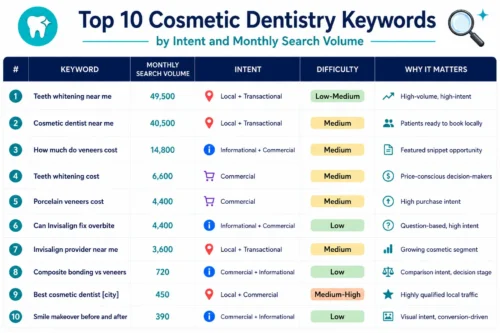
Keyword research determines whether your SEO campaign attracts website visitors or actual patients. Many cosmetic dental practices focus on broad dental keywords that generate traffic but fail to produce consultations. A stronger approach identifies the terms patients use when they are researching treatments, comparing providers, and preparing to book appointments.
For cosmetic dentistry, search intent matters more than search volume. A keyword with 100 monthly searches can generate more revenue than a keyword with 5,000 searches if the searcher is ready to schedule a consultation.
The highest-converting cosmetic dentistry keywords typically combine a treatment name with a location or purchase intent. These searches often signal that the patient is already evaluating providers rather than simply gathering information.
Keywords That Turn Searches Into Patient Calls
High-intent keywords attract people who are actively looking for treatment options.
Examples include:
- Cosmetic dentist near me
- Veneers specialist
- Smile makeover consultation
- Teeth whitening dentist
- Invisalign provider
- Dental bonding treatment
- Best cosmetic dentist in [city]
These searches show a strong commercial or transactional intent and typically generate more qualified leads compared to general informational searches.
A practice collaborating with our seo services for cosmetic dentists should focus on keywords that support consultation-driven objectives instead of vanity traffic metrics.
Using Location and Treatment Names Together
Local relevance remains a major ranking factor for cosmetic dentistry searches.
Patients frequently combine treatments with geographic modifiers such as:
- Veneers near me
- Invisalign in Ahmedabad
- Teeth whitening clinic near me
- Cosmetic dentist in Mumbai
- Smile makeover specialist in Delhi
Combining treatment keywords with local modifiers helps search engines connect your services with nearby patients.
A successful local seo for cosmetic dentist campaign builds dedicated pages around treatment-location combinations rather than relying on a single generic service page.
Examples of High-Converting Local Keywords:
| Treatment Keyword | Local Variation |
|---|---|
| Veneers | Veneers near me |
| Invisalign | Invisalign in Ahmedabad |
| Teeth Whitening | Teeth whitening dentist near me |
| Smile Makeover | Smile makeover specialist in [city] |
| Dental Bonding | Dental bonding clinic near me |
Keywords People Actually Ask as Questions
Voice search and AI search platforms continue to increase the importance of question-based keywords.
Common examples include:
- What is the price of veneers?
- How long does the effect of teeth whitening last?
- Are veneers a permanent solution?
- Which cosmetic dental procedure is most effective for discolored teeth?
- What is the cost of a smile makeover?
These questions create opportunities for blog posts, FAQs, service pages, and featured snippets.
When a seo company for cosmetic dentists develops content around patient questions, it captures users at the research stage and guides them toward consultation-focused pages.
A Simple Keyword Prioritization Framework
Use the following order when selecting target keywords:
- Transactional treatment keywords
- Commercial comparison keywords
- Local treatment keywords
- Question-based keywords
- Broad informational keywords
Practices that follow this hierarchy typically generate stronger consultation opportunities because keyword selection aligns with patient decision-making behavior.
"The best cosmetic dentistry keywords are not always the most searched keywords. They are the keywords most likely to lead to consultations."
Ready to refresh your brand?
Contact Upclues today and start your branding journey.
On-Page SEO for Cosmetic Dentist Websites
Writing Titles and Descriptions That Google Shows and Patients Click
Title tags and meta descriptions create the first impression in search results. Even if a page ranks well, poor metadata can reduce click-through rates and limit patient inquiries.
A strong title tag should include the primary treatment, location, and patient benefit. Cosmetic dentistry searches are highly competitive, so clarity often performs better than creativity.
Examples:
Good Title Tag
- Porcelain Veneers in California | Natural-Looking Smile Transformations
Weak Title Tag
- Welcome to Our Dental Website
Meta descriptions should encourage action while accurately describing the page content.
Best practices include:
- Mention the treatment
- Include a benefit
- Add a call to action
- Stay within recommended character limits
“Search rankings generate visibility, but compelling titles and descriptions generate clicks. Higher click-through rates often indicate stronger search relevance.”
Organizing Your Page with Clear Headings (H1, H2, H3) That Google Understands
Heading structure helps search engines understand the topic hierarchy of a page.
A cosmetic dentistry service page should contain:
- One H1 tag
- Multiple H2 sections
- Supporting H3 subsections
Example structure:
- H1: Porcelain Veneers
- H2: Benefits of Veneers
- H2: Veneer Treatment Process
- H2: Cost of Veneers
- H2: Frequently Asked Questions
- H3: How Long Do Veneers Last?
- H3: Are Veneers Permanent?
Clear headings improve both SEO and user experience because visitors can quickly find the information they need.
Getting Your Photos to Show Up in Google Images and Boost Rankings
Images play a major role in cosmetic dentistry marketing because patients want visual proof of treatment quality.
Every image should include:
- Descriptive file names
- Optimized alt text
- Compressed file sizes
- Relevant image captions
Example
Poor File Name
- IMG12345.jpg
Optimized File Name
- porcelain-veneers-before-after-ahmedabad.jpg
Before-and-after galleries can generate valuable image search traffic when properly optimized.
Schema Markup for Cosmetic Dental Practices
Schema markup helps search engines understand information about your practice.
Useful schema types include:
- LocalBusiness
- Dentist
- FAQ
- Review
- Service
- Breadcrumb
Schema does not directly improve rankings, but it can improve search visibility through rich results.
A practice working with a seo specialist for a cosmetic dentist strategy should implement structured data across service pages, FAQs, and location pages to improve content interpretation.
On-Page SEO Checklist for Cosmetic Dentists
- Optimize title tags.
- Write compelling meta descriptions.
- Use a clear heading structure.
- Add keyword-focused service pages.
- Optimize image files and alt text.
- Implement schema markup.
- Strengthen internal linking.
- Improve page readability.
"The best-performing cosmetic dental pages satisfy both search engines and patients. Rankings attract visitors, but page experience converts them into consultations."
Local SEO for Cosmetic Dentists
No financial rebrand can succeed if it ignores compliance. Regulators expect consistency between marketing, legal documents, and disclosures, especially when names, products, or risk profiles change. Compliance and regulatory considerations in a financial rebrand include reviewing naming rules, updating disclosures, ensuring risk language is accurate, and aligning marketing claims with what the firm is legally allowed to offer. A rebrand must pass legal and compliance sign‑off at every stage, from concept to rollout, to avoid misleading clients or violating rules such as the SEC’s Names Rule for funds.
Filling Out Your Google Business Listing Completely So Patients Find You Locally
A fully optimized Google Business Profile gives search engines and potential patients accurate information about your practice.
Key elements to complete include:
- Business name
- Primary and secondary categories
- Address
- Phone number
- Website URL
- Business hours
- Services offered
- Appointment links
- Photos and videos
- Business description
Numerous cosmetic dentists neglect to optimize the service level in their profiles. Including treatments like veneers, Invisalign, teeth whitening, and smile makeovers allows Google to better comprehend your services.
A properly managed profile also enhances visibility for local searches with high intent.
Google Business Profile Optimization Checklist
- Verify your listing.
- Add all cosmetic dental services.
- Upload high-quality practice photos.
- Include appointment booking links.
- Update holiday and business hours.
- Respond to reviews consistently.
Making Sure Your Name, Address, and Phone Are the Same Everywhere Online
Search engines use citations across the web to verify business legitimacy.
Your practice's:
- Name
- Address
- Phone Number (NAP)
should remain identical across:
- Healthcare directories
- Dental associations
- Local business listings
- Social media profiles
- Review platforms
Even small inconsistencies can create confusion for search engines.
A successful local seo for a cosmetic dentist campaign prioritizes citation accuracy because trust begins with data consistency.
Creating Pages for "Cosmetic Dentist in [City]" to Dominate Local Searches
Location pages help practices rank for geographically targeted searches.
Examples include:
- Cosmetic Dentist in California
- Veneers Specialist in California
- Smile Makeover Dentist in California
- Invisalign Provider in California
Each page should contain:
- Unique content
- Local patient information
- Service details
- Testimonials
- FAQs
- Contact information
Avoid copying the same content across multiple city pages. Unique local relevance performs significantly better.
Why Google Shows Dentists Near Customers Who Search Locally
Google's local algorithm primarily evaluates:
- Relevance
- Distance
- Prominence
Relevance
How closely your services match the search query.
Distance
How near is your practice to the searcher?
Prominence
How trusted and recognised your practice appears online.
Reviews, backlinks, local citations, and brand mentions all contribute to prominence. A dental practice working with the best seo company for a cosmetic dentist strategy often sees stronger local rankings because optimisation extends beyond the website into the broader local search ecosystem.
"Local SEO succeeds when search engines trust both your business information and your local authority. Rankings improve when relevance, distance, and prominence align."
Trust Signals That Convert
Cosmetic dentistry is one of the most trust-dependent healthcare services. Patients are not simply choosing a treatment. They are choosing the professional responsible for their appearance, confidence, and long-term satisfaction.
Even if a practice ranks highly in search results, weak trust signals can reduce consultation requests. Strong reviews, verified credentials, treatment results, and social proof help patients feel confident enough to take the next step.
“In cosmetic dentistry, trust signals often influence conversion rates more directly than rankings. Patients typically validate credibility before they schedule a consultation.”
Getting More Google Reviews (They Boost Rankings and Convince Patients)
Google reviews serve two important functions.
Firstly, they enhance local SEO effectiveness. Secondly, they offer confidence to potential patients when assessing various providers.
Patients often compare:
- Review quantity
- Average rating
- Review recency
- Review quality
- Provider responses
Practices with a steady flow of authentic reviews generally appear more trustworthy than competitors with limited feedback.
Best Practices for Generating Reviews
- Request reviews after successful treatments.
- Send review links via email or SMS.
- Make the review process simple.
- Respond professionally to all reviews.
- Thank patients for positive feedback.
- Address concerns respectfully when negative reviews occur.
Avoid purchasing reviews or using automated review schemes. Search engines can identify unnatural review patterns, and patients often recognize inauthentic testimonials.
A practice working with a seo specialist for a cosmetic dentist strategy should treat review generation as an ongoing reputation management process rather than a one-time campaign.
Displaying Your Licenses, Awards, and Certifications on Your Website
Professional credentials help validate expertise and authority.
Patients researching cosmetic procedures frequently review qualifications before contacting a provider.
Important credentials to showcase include:
- Dental licenses
- Professional memberships
- Cosmetic dentistry certifications
- Continuing education achievements
- Industry awards
- Speaking engagements
- Published articles
Create dedicated dentist profile pages that clearly communicate experience, training, and treatment expertise.
Additional Trust Signals That Improve Conversions
Beyond credentials and reviews, cosmetic dental websites should feature:
- Before-and-after galleries
- Video testimonials
- Case studies
- Media mentions
- Insurance information
- Transparent consultation processes
These elements reduce uncertainty and help prospective patients visualize outcomes.
A seo company for a cosmetic dentist strategy that combines visibility with credibility typically generates stronger consultation rates than SEO efforts focused solely on rankings.
"Patients rarely choose the first cosmetic dentist they find. They choose the provider they trust most after comparing available options."
Content Marketing for Cosmetic Dentists
Content marketing helps cosmetic dentists attract patients at every stage of the decision-making journey. Some people are learning about treatment options for the first time, while others are comparing providers and preparing to schedule consultations.
A successful content strategy answers questions, builds trust, demonstrates expertise, and guides potential patients toward booking an appointment. Strong content also supports rankings by helping search engines understand the depth and relevance of your expertise.
“The highest-performing cosmetic dental websites do not rely solely on service pages. They build topical authority through educational content that answers patient questions before competitors do.”
Writing Blog Posts and Pages for Different Stages
Patients rarely move from search to consultation in a single step.
Most follow a journey that includes research, comparison, and evaluation.
Effective content should support each stage.
Learning Stage
At this stage, patients want information.
Examples include:
- What are porcelain veneers?
- How does teeth whitening work?
- What is a smile makeover?
These articles attract informational searches and introduce patients to your practice.
Comparing Stage
Patients begin evaluating options and providers.
Examples include:
- Veneers vs dental bonding
- Invisalign vs traditional braces
- Professional whitening vs at-home whitening
Comparison content establishes your practice as a reliable advisor.
Deciding Stage
Patients are close to booking.
Examples include:
- Veneers cost in California
- Best cosmetic dentist for smile makeovers
- What happens during a cosmetic dental consultation?
Decision-stage content supports conversions and consultation requests.
A practice partnering with a best seo company for cosmetic dentist often develops content for all three stages instead of focusing exclusively on treatment pages.
Blog Posts and Pages About Treatments That Patients Actively Search For
Treatment-focused content targets keywords with strong commercial intent.
Popular content topics include:
- Porcelain veneers
- Teeth whitening
- Invisalign
- Smile makeovers
- Dental bonding
- Gum contouring
- Dental implants
Every treatment page should explain:
- Benefits
- Procedure steps
- Recovery expectations
- Costs and influencing factors
- Frequently asked questions
- Consultation process
Detailed treatment pages often perform better because they satisfy both user intent and search engine expectations.
Answering "What Is," "Why," and "How To" Questions That Patients Type in Google
Question-based content plays an increasingly important role in AI search, voice search, and featured snippets.
Examples include:
- What is cosmetic dentistry?
- Why do veneers cost more than bonding?
- How long does professional teeth whitening last?
- What should I expect after Invisalign treatment?
- How do smile makeovers improve confidence?
These questions provide opportunities to create FAQ sections, blog posts, and service page enhancements.
The one-time keyword SEO for dentists applies particularly well to content development because educational content remains one of the most effective ways for dental practices to build authority online.
A Simple Cosmetic Dental Content Framework
Create content using this structure:
- Educational blogs for awareness.
- Comparison content for evaluation.
- Treatment pages for conversion.
- FAQs for search visibility.
- Patient success stories for trust.
A local seo for a cosmetic dentist strategy becomes more effective when content supports local treatment searches and patient questions simultaneously.
"Content succeeds when it answers the patient's next question before they need to ask it. Every useful answer increases trust and moves the patient closer to consultation."
Technical SEO & UX for Cosmetic Dental Websites
Technical SEO ensures that search engines can efficiently crawl, understand, and rank your website. Even the best content and strongest keyword strategy can struggle to perform if technical issues prevent users and search engines from accessing information smoothly.
For cosmetic dental practices, technical SEO directly affects both rankings and patient experience. Whether we are auditing an existing site or providing healthcare website design services, we ensure that speed, mobile responsiveness, and usability are prioritized to build immediate patient trust.
“Technical SEO is often the difference between ranking potential and ranking performance. Many cosmetic dental websites have quality content but lose visibility because of avoidable technical issues.”
Making Your Website Load Fast (Slow Sites Rank Lower and Lose Patients)
Website speed influences user engagement, conversion rates, and visibility in search results.
Patients looking for cosmetic treatments anticipate quick-loading pages. Even a delay of a few seconds can lead to higher bounce rates and fewer consultation requests.
Common causes of slow websites include:
- Large image files
- Unoptimized code
- Excessive plugins
- Poor hosting infrastructure
- Unnecessary scripts
Ways to Improve Website Speed
- Compress images before uploading.
- Use modern image formats.
- Enable browser caching.
- Minify CSS and JavaScript files.
- Remove unused plugins and scripts.
- Choose reliable hosting.
Before-and-after galleries are valuable for cosmetic dentists, but they must be optimized to avoid slowing page performance.
Most Patients Use Phones to search; your site must work on Mobile
Mobile usability is no longer optional.
Many prospective patients research treatments, compare dentists, and request consultations directly from smartphones.
A mobile-friendly website should provide:
- Fast loading times
- Easy navigation
- Click-to-call functionality
- Readable text
- Mobile-responsive layouts
- Simple appointment forms
Google primarily uses mobile-first indexing, meaning it evaluates the mobile version of your website when determining rankings.
A seo specialist for cosmetic dentist strategy typically includes regular mobile usability testing because user behavior continues shifting toward mobile devices.
Organizing Your Website So Google Can Easily Find and Understand All Your Pages
Website architecture helps search engines discover and interpret content.
A clear structure may look like:
- Home
- Cosmetic Dentistry
- Veneers
- Teeth Whitening
- Invisalign
- Smile Makeovers
- About
- Reviews
- Blog
- Contact
Logical navigation improves both user experience and crawl efficiency.
Internal linking also helps distribute authority throughout the website while guiding visitors toward relevant information.
Finding and Fixing Broken Links and Problems That Hurt Your Rankings
Technical issues can reduce visibility and create a poor user experience.
Common problems include:
- Broken links
- Missing pages (404 errors)
- Redirect chains
- Duplicate content
- Missing metadata
- Crawl errors
Regular technical audits help identify and resolve these issues before they affect rankings. A seo guide for dentists should always include technical maintenance because long-term SEO success depends on a healthy website foundation. Partnering with a provider of SEO services for dentists can help identify and resolve these issues before they affect your rankings. "Technical SEO creates the infrastructure that allows content, authority, and trust signals to perform at their highest potential."
Link Building for Cosmetic Dentists
Link building helps cosmetic dental practices increase authority, improve search visibility, and strengthen trust in the eyes of search engines. When reputable websites link to your practice, they effectively signal that your content, services, and expertise deserve attention.
However, not all backlinks provide value. Low-quality links, paid link schemes, and spammy directory submissions can create long-term SEO problems. Successful link building focuses on earning relevant, trustworthy mentions rather than accumulating large numbers of links.
“In healthcare SEO, relevance often matters more than volume. Ten high-quality dental or local authority links can outperform hundreds of low-quality backlinks.”
Why Links from Dental Websites Help You Rank Higher in Cosmetic Dentistry
Industry-relevant links provide stronger contextual signals than unrelated websites.
Examples include:
- Dental associations
- Continuing education
- organizations
- Dental publications
- Healthcare blogs
- Industry directories
These websites already possess topical authority within dentistry, making their endorsements more valuable.
A backlink from a respected dental resource helps search engines better understand your expertise within cosmetic dentistry.
Sources to get Links: Dental Associations, Local News, and Healthcare Directories
Many cosmetic dentists overlook legitimate backlink opportunities that already exist within their industry.
Potential sources include:
- Professional dental associations
- Chamber of Commerce websites
- Local healthcare directories
- Community organizations
- Business networking groups
- Regional news publications
A seo company for cosmetic dentistry strategy should prioritize authoritative and relevant sources rather than pursuing backlinks from unrelated websites.
High-Quality Backlink Opportunities
- Dental association membership listings.
- Local business directories.
- Healthcare provider directories.
- Community sponsorship pages.
- Educational partnerships.
- Professional organization profiles.
Writing Articles for Dental Magazines and Getting Local Press Mentions for Backlinks
Thought leadership remains one of the most sustainable link-building approaches.
Cosmetic dentists can contribute:
- Expert commentary
- Treatment insights
- Industry trends
- Patient education articles
- Smile transformation success stories
Publications often reward useful expertise with editorial backlinks.
Local media coverage can also generate valuable authority signals while increasing brand awareness.
Turning Patient Transformations into Content That Other Sites Want to Link To
Successful cosmetic treatments create compelling stories.
With proper patient consent, practices can develop:
- Before-and-after case studies
- Treatment journey content
- Educational transformation stories
- Video testimonials
- Patient success features
These assets naturally attract links because they provide unique information that cannot be replicated elsewhere.
The best seo company for cosmetic dentist campaign often uses original treatment-based content as a long-term authority-building asset.
"The safest and most effective backlinks are earned through expertise, education, and community authority rather than artificial link-building tactics."
Common SEO Mistakes Cosmetic Dentists Make
Even well-designed cosmetic dental websites can struggle to rank when fundamental SEO mistakes limit visibility and user experience. Many practices invest in content and marketing but overlook issues that directly affect rankings, traffic quality, and patient conversions.
“Most cosmetic dental SEO failures occur because practices focus on gaining visibility while ignoring the experience patients receive after they arrive on the website.”
Mistake #1: Keyword Stuffing & Over-Optimization
Some websites repeatedly insert the same keyword throughout a page in an attempt to improve rankings.
Modern search engines prioritize relevance and readability over repetition.
Common examples include:
- Unnatural keyword placement
- Repetitive headings
- Forced service descriptions
- Duplicate content across pages
Content should answer patient questions naturally while maintaining clear topical relevance.
Mistake #2: Ignoring Mobile Users
Most cosmetic dentistry searches now happen on mobile devices.
A website that loads slowly, displays poorly, or creates navigation challenges on smartphones can lose potential consultations quickly.
Important mobile considerations include:
- Responsive design
- Fast page speed
- Click-to-call functionality
- Mobile-friendly forms
Mistake #3: Poor Review Management
Reviews influence both local rankings and patient trust. Ignoring reviews, failing to respond, or allowing outdated feedback to dominate your profile can weaken credibility.
Practices that actively request, monitor, and respond to reviews often build stronger trust signals and improve local search performance over time.
"SEO success depends on avoiding the small mistakes that quietly reduce visibility, trust, and conversion opportunities."
How to Measure Your Cosmetic Dental SEO Performance
SEO performance should be measured using business outcomes, not rankings alone. The ultimate goal is to generate more qualified consultations, treatment inquiries, and revenue opportunities.
‘Cosmetic dental SEO delivers the highest value when traffic growth translates into consultation requests and booked treatments.”
How Long Does SEO Take for a Cosmetic Dental Practice?
Most cosmetic dental practices begin seeing measurable improvements within 3 to 6 months, depending on competition, website authority, and market conditions.
Typical timeline:
- Months 1-2: Technical fixes and optimization
- Months 3-4: Ranking improvements
- Months 4-6: Traffic and lead growth
- Months 6+: Stronger authority and sustained results
Key Metrics: Organic Traffic, Keyword Rankings, GBP Impressions, Consultation Requests
Track metrics that directly support business growth:
- Organic traffic
- Keyword rankings
- Google Business Profile
- impressions
- Phone calls
- Consultation requests
- Appointment bookings
- Conversion rates
A local seo for cosmetic dentist campaign should measure both ranking visibility and lead generation performance.
Conclusion
Successful cosmetic dental SEO goes beyond improving rankings. It combines keyword targeting, local visibility, trust signals, content authority, technical optimization, and reputation management to attract patients who are actively searching for treatment solutions.
Practices that invest in a long-term SEO strategy position themselves to earn more consultation requests, strengthen credibility, and compete effectively in local markets.
Consistent optimization across every stage of the patient journey creates sustainable growth that paid advertising alone cannot match.
At Upclues, A Branding & UI/UX Design Agency, we help healthcare brands build stronger digital experiences that support visibility, trust, and patient conversions. If you're ready to strengthen your seo for cosmetic dentists strategy, start by evaluating your current online presence and identifying the opportunities that can generate the greatest impact.
FAQs About SEO for Cosmetic Dentists
What is SEO for cosmetic dentists?
SEO for cosmetic dentists is the process of improving a practice's visibility in search engines so potential patients can find treatments such as veneers, teeth whitening, Invisalign, and smile makeovers. The goal is to increase qualified traffic, consultations, and patient conversions.
How long does it take to see results from cosmetic dentist SEO?
Most cosmetic dental practices start seeing measurable improvements within 3 to 6 months. Competitive markets may require additional time to achieve significant ranking and lead-generation growth.What keywords should a cosmetic dentist target?
Cosmetic dentists should prioritize high-intent keywords such as:- Cosmetic dentist near me
- Veneers near me
- Smile makeover cost
- Teeth whitening dentist
- Invisalign provider
- Cosmetic dentist in [city]
How is local SEO different from regular SEO for dentists?
Local SEO focuses on helping a practice appear in location-based searches, Google Maps, and Google Business Profile results. It targets nearby patients who are looking for cosmetic dental services in a specific area.What are trust signals and why do they matter for dental websites?
Trust signals are elements that help patients feel confident about choosing a provider. Examples include patient reviews, professional certifications, before-and-after galleries, awards, and testimonials. Strong trust signals improve both credibility and conversion rates.Is SEO or Google Ads better for cosmetic dentists?
Both can be effective. Google Ads provides immediate visibility, while SEO builds long-term organic traffic and sustainable patient acquisition. Many successful practices use both strategies together.How much does SEO for a cosmetic dental practice typically cost?
SEO costs vary based on competition, market size, and service scope. Most cosmetic dental practices invest anywhere from a few hundred to several thousand dollars per month depending on their growth goals and SEO requirements.Ready to refresh your brand?
Contact Upclues today and start your branding journey.