


SEO for Lawyers: The Complete Guide to Growing Your Law Firm
July 22, 2026
SEO for Herbal Products: The Complete Guide for Ayurvedic Supplement Manufacturers
August 1, 2026SEO for Lawyers: The Complete Guide to Growing Your Law Firm
July 22, 2026SEO for Herbal Products: The Complete Guide for Ayurvedic Supplement Manufacturers
August 1, 2026How Website Design for Gastroenterology Shapes Patient First Impressions
July 27, 2026
- 15 min to Read
Overview
- A well-designed gastroenterology website builds patient trust before the first appointment.
- Clear navigation, educational content, and online scheduling help convert visitors into patients.
- SEO, user experience, and mobile performance work together to improve visibility and increase appointment requests.
- The best gastroenterology websites focus on solving patient concerns while making it easy to find information and book care.
Introduction
Patients often form an opinion about a medical practice before they make a phone call or schedule an appointment. Your website has become the first interaction many people have with your practice, making website design for gastroenterology a key factor in building credibility, answering patient questions, and encouraging appointment requests. Research consistently shows that website quality influences how users perceive trust and professionalism, especially in healthcare.
A gastroenterology website should do more than display services. It should guide visitors through symptoms, treatments, physician credentials, insurance information, and appointment options with clarity.
At Upclues, we help healthcare organizations create patient-focused digital experiences that combine modern design, user experience, and strategic optimization to support long-term practice growth.
What Is a Gastroenterology Website Design?
A gastroenterology website design is a patient-focused website built specifically for digestive healthcare practices. It organizes services, physician information, patient education, appointment scheduling, and trust signals into an intuitive experience that helps visitors quickly find answers and confidently book care.
Unlike a generic medical website, gastroenterology website design addresses the unique concerns of patients seeking treatment for digestive disorders. Many visitors arrive with symptoms they may find difficult or uncomfortable to discuss. A clear, professional website helps reduce uncertainty by presenting information in a reassuring and easy-to-understand format.
An effective website should guide patients through every stage of their journey, from learning about symptoms and treatment options to scheduling an appointment with confidence. Every page should answer common questions and make it easy to contact the practice.
Key objectives of a gastroenterology website include:
- Present physicians and their expertise clearly.
- Explain GI conditions and available treatments in patient-friendly language.
- Make online appointment scheduling simple and accessible.
- Showcase patient reviews, certifications, and affiliations to build credibility.
- Deliver a fast, mobile-friendly browsing experience.
- Help patients quickly find locations, insurance information, and contact details.
The strongest healthcare websites balance visual appeal with functionality. Rather than focusing only on aesthetics, every design decision should improve usability, accessibility, and patient confidence.
A useful way to think about it is this:
| Traditional Practice Website | Patient-Centered Gastroenterology Website |
|---|---|
| Lists services only | Explains conditions, treatments, and outcomes clearly |
| Complex navigation | Simple, intuitive navigation for all age groups |
| Basic contact page | Multiple appointment and contact options |
| Limited trust signals | Reviews, physician credentials, FAQs, and certifications |
| Static information | Educational resources that help patients make informed decisions |
When these elements work together, your website becomes more than an online brochure. It becomes an extension of your patient experience, supporting education, trust, and appointment generation before the first consultation.
“Patients evaluate a healthcare provider's credibility long before they walk into the clinic. A website that answers questions, reduces uncertainty, and simplifies the next step often creates the strongest first impression. ”
Why Does Expert Website Design for Gastroenterology Matter?
An expertly designed gastroenterology website builds patient trust before the first appointment. It helps visitors understand your services, learn about your physicians, and schedule appointments with confidence while improving your practice's visibility and credibility.
Most patients begin their healthcare journey online, comparing providers, reading reviews, and exploring websites before making a decision. A modern, user-friendly website reflects your professionalism and commitment to patient care. If patients cannot quickly find information or book an appointment, they are likely to choose another provider instead.
Here's why professional design makes a measurable difference:
Builds Trust Before the First Visit
Patients dealing with digestive health concerns want reassurance. A clean interface, physician profiles, patient testimonials, and transparent service information help reduce uncertainty and establish confidence before the first consultation.
Improves Patient Experience
An intuitive website minimizes frustration. Clear menus, readable content, responsive design, and accessible navigation make it easier for patients of every age to find the information they need.
Supports Better Search Visibility
A well-structured website helps search engines better understand your content, making it easier for potential patients to discover your practice. Combining thoughtful design with strong technical foundations creates a better experience for both users and search engines.
Increases Appointment Requests
Every page should guide visitors toward a clear action, whether that's scheduling an appointment, contacting your office, or requesting additional information. Reducing unnecessary clicks and simplifying booking pathways can significantly improve conversion rates.
Strengthens Your Competitive Position
Many practices offer similar medical services, but their digital experiences vary widely. The best gastroenterology websites differentiate themselves by combining educational content, intuitive navigation, trust signals, and patient-focused design into one cohesive experience.
As patient expectations continue to evolve, investing in a better website is no longer optional. A high-performing digital presence supports stronger engagement, improves patient satisfaction, and creates a competitive advantage for your practice.
Common Patient Pain Points Before Choosing a GI Practice
Patients searching for a gastroenterologist often feel uncertain and want clear, trustworthy information before booking an appointment. If your website doesn't address their concerns, they may choose another provider.
Common pain points include:
Difficulty Finding Relevant Information
Patients want quick access to details about digestive conditions, treatments, physician expertise, accepted insurance plans, and clinic locations. When essential information is buried or incomplete, visitors may question the practice's transparency and professionalism.
Uncertainty About the Doctor's Expertise
Digestive health concerns often require specialized care. Patients look for physician credentials, years of experience, areas of specialization, certifications, and real patient reviews before making a decision. A website design for gastroenterologists should highlight these trust-building elements prominently.
Complicated Appointment Scheduling
Patients expect online convenience. Lengthy contact forms, missing appointment options, or unclear contact information increase frustration and reduce conversion opportunities. Simple scheduling workflows create a better patient experience.
Lack of Educational Resources
Many visitors search for symptoms and treatment information before contacting a clinic. A website that explains procedures, common gastrointestinal conditions, and treatment options in clear language helps patients feel informed and more comfortable seeking care.
Poor Mobile Experience
A significant portion of healthcare searches now happen on smartphones. Slow-loading pages, difficult navigation, and unreadable content often cause visitors to leave before exploring the practice further. Mobile responsiveness is no longer optional for Website design for gastroenterology practices because it directly affects usability and patient satisfaction.
Key Takeaway: A patient-focused website removes friction, answers common questions, and makes scheduling an appointment simple and reassuring.
Ready to refresh your brand?
Contact Upclues today and start your branding journey.
What Patients Look for in a Gastroenterology Website
Patients expect a gastroenterology website to be informative, easy to navigate, and trustworthy. A positive online experience helps them feel confident about choosing your practice and taking the next step.
Here's what patients value most:
- Clear information about GI conditions and treatments.
- Physician profiles with qualifications and experience.
- Simple navigation to services, locations, and contact details.
- Online appointment scheduling with minimal steps.
- Mobile-friendly, fast-loading pages.
- Patient testimonials and credibility indicators.
- Insurance, FAQs, and patient resources in one place.
“Patients are more likely to trust and engage with healthcare websites that provide clear answers, transparent information, and an effortless user experience.”
Core Elements of the Best Gastroenterology Websites
The best gastroenterology websites combine patient-focused design, clear communication, and conversion-driven functionality. Every element should make it easier for visitors to understand your services, trust your expertise, and schedule an appointment. A well-planned Website design for a gastroenterology medical practice supports both patient satisfaction and long-term practice growth.
1. Clear Navigation and Information Architecture
Patients visit your website with a specific goal, whether it's learning about a digestive condition, finding a specialist, or booking an appointment. Organizing content into intuitive menus with clearly labeled pages helps users find what they need quickly without frustration.
2. Mobile-Responsive Design
Most healthcare searches now happen on smartphones. A responsive website automatically adjusts to different screen sizes, ensuring patients can easily browse services, complete forms, and contact your practice from any device.
3. Fast Loading Performance
Patients expect pages to load almost instantly. Slow websites often lead to higher bounce rates and missed appointment opportunities. Optimizing images, improving Core Web Vitals, and reducing unnecessary scripts create a faster and more reliable browsing experience.
4. Strong Trust Signals
Healthcare decisions rely heavily on trust. Showcase physician credentials, board certifications, patient testimonials, awards, hospital affiliations, and professional memberships to reassure prospective patients that they're choosing a qualified provider.
5. Service Pages That Answer Patient Questions
Each treatment page should explain symptoms, causes, diagnosis, treatment options, recovery expectations, and when patients should seek medical care. Educational content reduces uncertainty and encourages visitors to take the next step.
6. Simple Online Appointment Booking
Every important page should include a clear call-to-action that guides patients toward scheduling an appointment. Short booking forms, click-to-call buttons, and prominent contact information reduce friction and improve conversion rates.
7. Accessibility and User Experience
A healthcare website should be easy for everyone to use, including older adults and people with disabilities. Readable typography, sufficient color contrast, keyboard navigation, and descriptive headings create an inclusive experience that benefits all visitors.
8. SEO-Ready Website Structure
An attractive website delivers limited value if patients cannot find it online. Combining clean code, optimized page structure, schema markup, and content strategy improves search visibility while creating a better user experience. Pairing these efforts with professional SEO Content Writing helps each page answer patient questions while targeting relevant search intent.
As your practice grows, your website should evolve alongside it. Investing in thoughtful design, high-quality content, and ongoing optimization creates a digital experience that supports both patient needs and business objectives.
9. HIPAA-Compliant Forms and Secure Patient Communication
Every contact form, appointment request, and intake form on a gastroenterology website has the potential to collect Protected Health Information (PHI) - even something as simple as a patient describing symptoms in a message field. If that data isn't transmitted and stored securely, the practice is exposed to compliance risk, and patients lose confidence in submitting personal health details online.
A trustworthy gastroenterology website should clearly demonstrate:
- SSL encryption (HTTPS) across every page, not just the contact form.
- HIPAA-compliant form software for appointment requests, new patient intake, and any field that could capture symptom or health information.
- Secure patient portal integration for lab results, prep instructions, and messaging, rather than standard unencrypted email.
- A visible privacy and security statement, briefly explaining how patient information is protected, placed near appointment and contact forms.
This isn't only a legal safeguard - it's a visible trust signal. Patients who are already hesitant to describe a digestive symptom in writing are more likely to complete a form when they see clear assurance their information is handled securely. Pairing this with basic ADA accessibility compliance (keyboard navigation, screen-reader-friendly forms, sufficient contrast) further strengthens both patient trust and legal compliance.
Why Every Gastroenterology Website Needs a Dedicated Referring Physician Page
Most patient-facing gastroenterology content focuses entirely on the person searching for a doctor. But a significant share of GI patient volume doesn't come from a Google search at all - it comes from a referral. Primary care physicians send patients for colonoscopies, suspicious symptoms, and specialist follow-up every day, and the practices that make that referral process effortless tend to win more of that volume.
Despite this, most gastroenterology websites have no page built specifically for referring providers. That's a missed opportunity both for patient acquisition and for building your practice's reputation among the medical community.
What Belongs on a Referring Physician Page
- A simple, HIPAA-compliant referral form that captures what a referring provider needs to submit quickly, either downloadable or online.
- Turnaround-time expectations - how soon a referred patient will typically be seen for routine versus urgent cases.
- A dedicated contact for a referral coordinator, separate from the general patient-facing phone number.
- A services summary written for a clinical audience, so referring physicians can quickly confirm your practice is the right fit for a specific case.
- Communication commitments - how and when the referring provider will receive a consultation summary or follow-up note.
Adding this single page signals professionalism to the referral network your practice depends on, and it gives your SEO strategy a page to target low-competition terms like "refer a patient to gastroenterologist" or "[City] GI referral form" - phrases most competitor websites overlook entirely.
How to Build Trust and Online Authority for Your Practice
Trust is one of the biggest factors influencing a patient's decision to choose a healthcare provider. Before scheduling an appointment, most people evaluate your website to determine whether your practice appears experienced, credible, and patient-focused. An effective Website design for gastroenterology practices should reinforce that trust at every stage of the patient journey.
A professional website doesn't just present information - it demonstrates your expertise, highlights your qualifications, and reassures patients that they are choosing the right provider for their digestive health needs.
Showcase Physician Credentials
Patients are interested in knowing who will be responsible for their treatment. Create dedicated physician profile pages that include qualifications, board certifications, areas of specialization, years of experience, professional memberships, and a brief personal introduction. Adding professional photographs and videos can make your team more approachable while strengthening credibility.
Highlight Patient Reviews and Testimonials
Authentic patient feedback is one of the strongest trust signals on a healthcare website. Positive reviews help prospective patients understand the quality of care they can expect and reduce hesitation before booking an appointment. Featuring testimonials throughout your website, rather than on a single page, reinforces credibility across the patient journey.
Demonstrate Clinical Expertise Through Educational Content
Publishing informative articles, treatment guides, FAQs, and procedure explanations positions your practice as a trusted source of digestive health information. Educational resources not only answer patient questions but also demonstrate your commitment to patient care beyond the consultation room.
Maintain a Consistent Brand Experience
From your homepage to your appointment page, every element should reflect a consistent visual identity and tone of voice. Consistent colors, typography, messaging, and imagery create a professional impression and help patients recognize your brand across every interaction. This is where investing in professional Healthcare Website Design can significantly improve both credibility and user confidence.
Make Contact Information Easy to Find
Patients should never have to search for your phone number, office hours, directions, or appointment options. Display this information prominently in the website header, footer, and contact page, ensuring visitors can reach your practice within seconds.
Keep Your Website Updated
An outdated website can make even an experienced practice appear inactive. Regularly updating physician information, treatment pages, blog content, and patient resources demonstrates that your practice remains engaged, current, and committed to delivering quality care.
“Expert Insight: Trust isn't built through one feature alone. It develops when every page consistently communicates expertise, transparency, and a patient-first approach.”
How Website Design Supports Patient Education and Awareness
A well-designed website doesn't just promote your services—it empowers patients with reliable information before they visit your clinic. For many people experiencing digestive symptoms, your website is their first source of guidance. Providing educational content builds confidence, answers common questions, and helps patients make informed healthcare decisions.
An effective Website Design organizes educational resources into easy-to-navigate pages that explain conditions, symptoms, diagnostic procedures, treatment options, and recovery expectations. Instead of overwhelming visitors with medical terminology, present information in clear, patient-friendly language that is easy to understand.
Create Educational Content That Patients Value
Patients often search for answers before scheduling an appointment. Publishing blogs, FAQs, treatment guides, and preventive care articles helps address these concerns while demonstrating your expertise. Educational content also keeps visitors engaged, increasing the likelihood that they will explore additional services or contact your practice.
Use Visual Content to Simplify Complex Topics
Digestive disorders and medical procedures can be difficult to explain with text alone. Diagrams, illustrations, videos, and infographics make complex concepts easier to understand, improving the overall patient experience.
Keep Information Updated
Healthcare information evolves over time. Regularly reviewing and updating educational pages ensures your website remains accurate, relevant, and trustworthy for both patients and search engines. Following Optimization Tips & strategies for Healthcare Website Design can also improve content quality, accessibility, and long-term search performance.
Encourage Patients to Take the Next Step
Every educational page should naturally guide readers toward scheduling a consultation or learning more about a related treatment. Clear calls-to-action transform educational resources into valuable patient acquisition tools without appearing overly promotional.
Reducing Procedure Anxiety With Prep Instructions and "What to Expect" Content
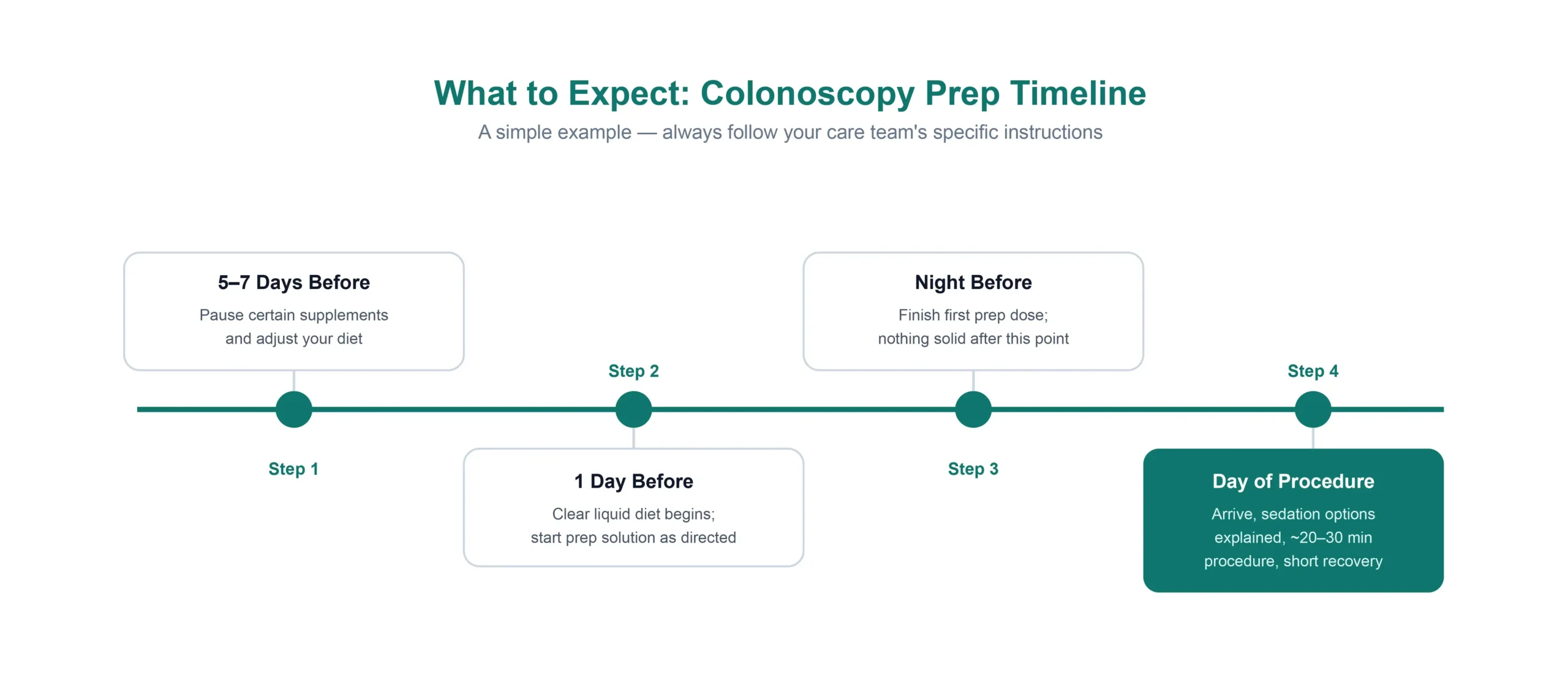
Example of a patient-friendly prep timeline - always link to your own clinical instructions
Addressing anxiety directly in your content - rather than only listing clinical facts - measurably improves both patient trust and appointment conversion.
Content That Reduces Pre-Procedure Anxiety
- Step-by-step prep timelines. A simple visual or day-by-day breakdown of what to do 3 days, 1 day, and the morning of a colonoscopy removes the guesswork that causes patients to cancel or postpone.
- "What to Expect" pages for every procedure. Walk through check-in, sedation options, procedure length, recovery room, and when results are typically shared.
- Plain-language reassurance about sedation and discomfort. Many patients avoid colonoscopies specifically out of fear of pain - addressing sedation options directly on the procedure page removes a major objection.
- A non-clinical, empathetic tone on symptom pages. Instead of purely listing symptoms, acknowledge the topic may feel uncomfortable and reassure patients these conversations are routine for the care team.
- An optional self-assessment tool. A short, interactive symptom checker or "should I be screened" quiz gives hesitant visitors a low-pressure way to engage before committing to a phone call or booking form.
Key Takeaway: This kind of content doesn't just help patients - it also supports referring physicians, who often need a resource to hand a nervous patient explaining what comes next.
Dominating Local SEO and "Near Me" Patient Searches
When patients search for a gastroenterologist, they usually include location-based terms such as "gastroenterologist near me" or a specific city. Optimizing your website for Local SEO helps your practice appear in these high-intent searches, connecting you with patients who are ready to book an appointment.
For example, if your practice serves Southern California, creating location-specific pages around terms like Gastroenterology website design Orange County can improve local visibility while providing relevant information to nearby patients. Instead of creating duplicate pages for every city, develop unique content that highlights your services, office locations, physician expertise, and community presence.
Best Practices for Improving Local Visibility
- Create dedicated pages for each clinic location.
- Keep your practice name, address, and phone number consistent across all platforms.
- Add Google Maps and clear driving directions to every location page.
- Encourage satisfied patients to leave genuine online reviews.
- Use location-specific service pages that address local patient needs.
- Implement healthcare schema markup to help search engines understand your practice.
Your website should also make it easy for visitors to contact your office. Prominently displaying your phone number, office hours, and appointment options reduces friction and improves conversion rates for local visitors.
A strong local presence works best when your website, Google Business Profile, and patient reviews support one another. Together, they increase your visibility in local search results and strengthen your practice's online reputation.
Optimizing Your Gastroenterology Website for AI Search and Generative Engines (GEO)
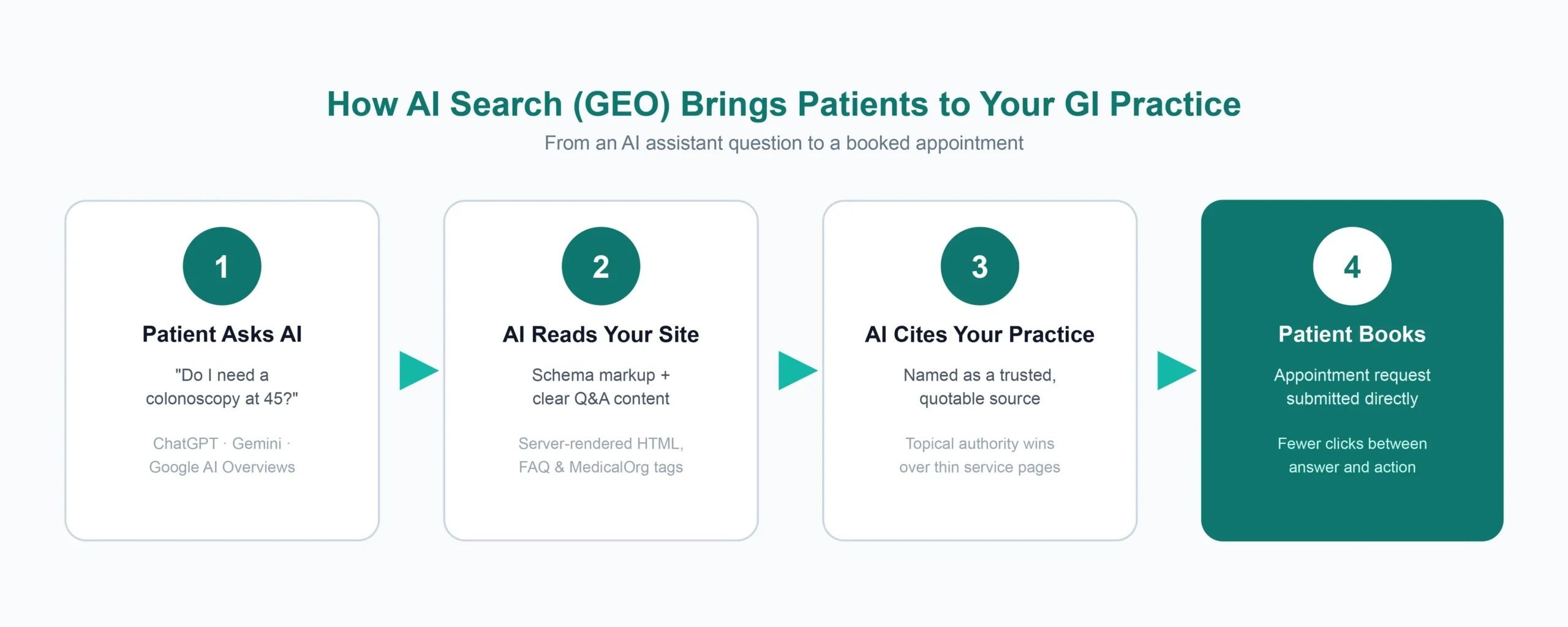
How Generative Engine Optimization (GEO) fits into the patient journey
Generative Engine Optimization (GEO) is the practice of structuring your website so AI systems can read, understand, and cite it correctly. Unlike traditional SEO, GEO cares less about keyword density and more about clarity, structure, and machine-readable trust signals.
How to Make Your Gastroenterology Website AI-Search Ready
- Use structured data (schema markup). Add MedicalOrganization, Physician, and FAQPage schema to every service and provider page so AI tools can immediately identify who you are, what conditions you treat, and where you practice.
- Write in clear question-and-answer formats. AI engines favor content that directly answers a specific question in the first sentence or two, followed by supporting detail. Structure your FAQs and condition pages this way.
- Avoid content locked behind JavaScript. Many AI crawlers can only read server-rendered HTML. If treatment descriptions or FAQs load dynamically through scripts, they may never be indexed or quoted by AI engines.
- Build topical authority, not just keyword pages. AI systems favor sites that comprehensively cover a subject area. A gastroenterology practice with in-depth pages on colonoscopy, GERD, IBS, and liver disease is more likely to be cited than one with a single generic "services" page.
- Keep information current. AI models often prioritize recently updated, dated content when answering health-related queries, so refreshing publish and "last updated" dates on key pages matters.
Key Takeaway: Practices that invest early in AI-search readiness are positioned to be the recommended answer when a patient asks an AI assistant a question - not just another blue link competing on page one.
Website Architecture for Multi-Location Gastroenterology Groups
Gastroenterology is consolidating quickly. Private-equity-backed platforms, multi-location GI groups, and hospital-affiliated GI service lines are increasingly common — yet most gastroenterology website design is still written and built for a single-location, single-physician practice.
If a group is managing 5, 15, or 50 locations, the website needs a fundamentally different content architecture than a solo practice site.
What Changes for Multi-Location GI Websites
- Location pages with unique, non-duplicated content. Each office needs its own page with local providers, hours, and location-specific patient information — not a templated page with only the address swapped out.
- A "Find a Provider" and "Find a Location" search tool, rather than a static list, once a group passes roughly 5–10 locations.
- Centralized service-line pages that link out to relevant locations. A page about colonoscopy screening should link to every location that performs the procedure.
- A scalable design system, so adding a new location or acquired practice doesn't require a custom page build from scratch every time.
- Consistent branding with local flexibility, preserving the local reputation and patient trust that acquired practices bring with them.
Key Takeaway: For a growing GI group, this isn't just a design preference — it directly affects SEO. Search engines and AI answer engines both reward sites that clearly map services to specific locations.
The Role of Content in Website Design for a Gastroenterology Medical Practice
An attractive website may capture attention, but valuable content is what builds trust and converts visitors into patients. Website design for a gastroenterology medical practice should work hand in hand with high-quality content to educate patients, answer their questions, and encourage them to schedule an appointment.
Patients rarely book a consultation after viewing only the homepage. They explore treatment pages, physician profiles, FAQs, blogs, and patient resources to determine whether your practice is the right choice. Every piece of content should address a specific patient concern while guiding them toward the next step in their healthcare journey.
Create Service Pages That Answer Patient Questions
Each service page should go beyond listing treatments. Explain who the treatment is for, common symptoms, diagnostic methods, available procedures, expected recovery, and when patients should seek medical attention. Comprehensive content helps patients make informed decisions while improving search visibility.
Publish Educational Blogs Regularly
A blog allows your practice to answer common questions about digestive health, screening procedures, nutrition, and preventive care. Consistently publishing educational articles demonstrates expertise, keeps your website fresh, and supports long-term organic growth.
Building a Gastroenterology Content Library: The Core Topics Patients Search For
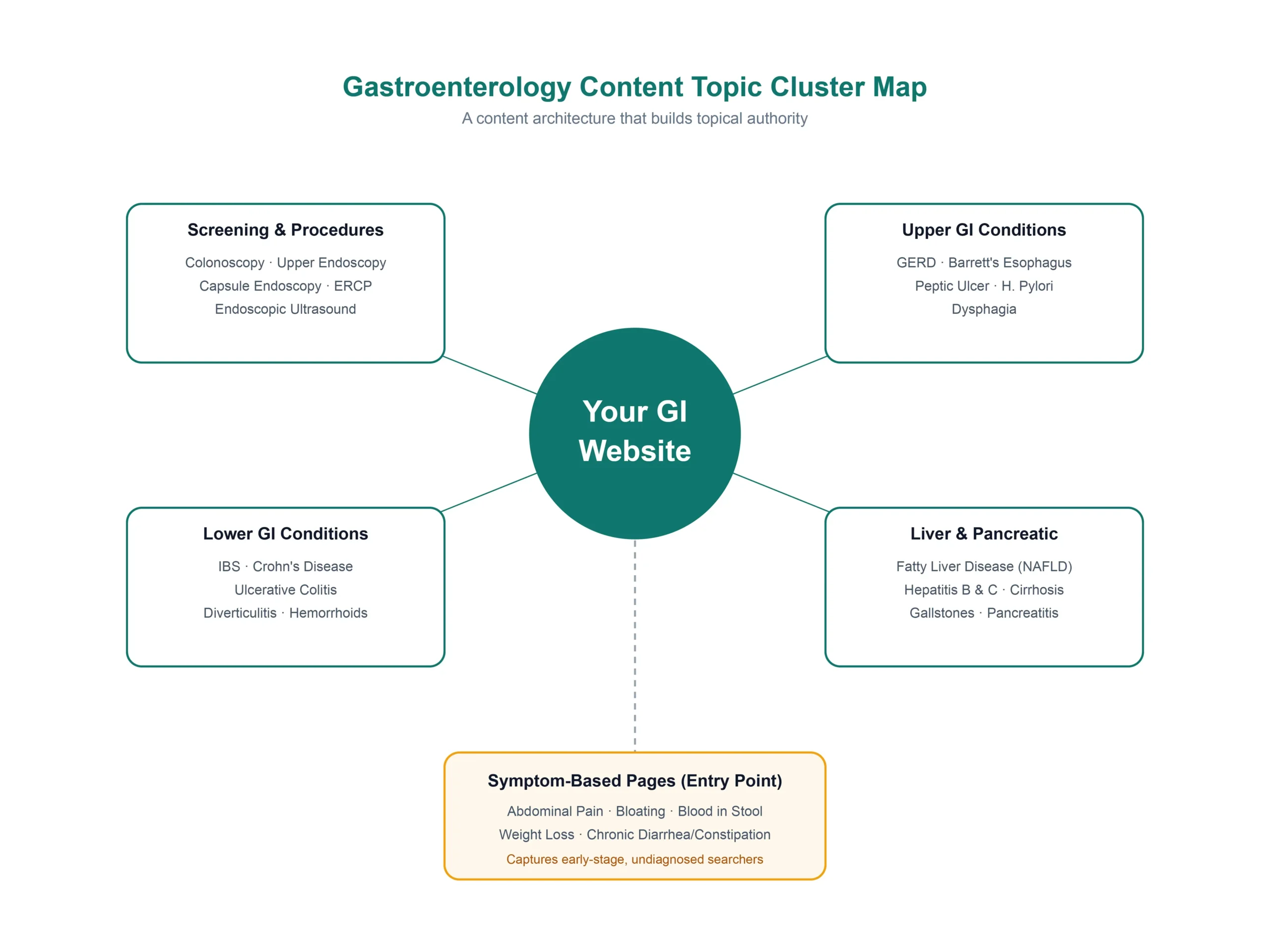
A sample content architecture for building topical authority in gastroenterology
Upper GI Conditions: GERD / Acid Reflux · Barrett's Esophagus · Peptic Ulcer Disease · H. Pylori Infection · Dysphagia
Lower GI Conditions: IBS · Crohn's Disease · Ulcerative Colitis · Diverticulitis · Colon Polyps · Hemorrhoids
Liver & Pancreatic Conditions: Non-Alcoholic Fatty Liver Disease (NAFLD) · Hepatitis B & C · Cirrhosis · Gallstones · Pancreatitis
Symptom-Based Pages (these capture early-stage searchers who haven't been diagnosed yet): Abdominal Pain · Chronic Bloating · Blood in Stool · Unexplained Weight Loss · Chronic Diarrhea or Constipation
Practices don't need to publish all of these at once. A realistic approach: prioritize the 8–10 conditions and procedures that represent the highest patient volume, publish those first with real depth, and expand the library over time. This structure also gives internal linking a natural framework — symptom pages link to condition pages, which link to procedure pages, which link to the appointment request form.
Build Trust with Helpful Resources
Adding FAQs, downloadable patient guides, preparation instructions for procedures, insurance information, and aftercare resources improves the overall patient experience. Helpful content reduces uncertainty and minimizes repetitive questions for your front-office staff.
Organize Content for Better Readability
Patients often scan rather than read every word. Use descriptive headings, short paragraphs, bullet points, and clear calls-to-action to make important information easy to find. A well-structured content hierarchy benefits both users and search engines.
Focus on Quality Over Quantity
Publishing fewer, high-value articles is more effective than creating large volumes of thin content. Every page should serve a clear purpose, answer real patient questions, and demonstrate your practice's expertise. This is where partnering with an Experienced SEO Agency can help develop a sustainable content strategy that aligns with both patient intent and search engine best practices.
How to Structure Service Pages for Better Patient Understanding
Your service pages are often the most visited pages on your website because they answer the exact questions patients are searching for. A well-structured service page should educate visitors, build confidence, and encourage them to schedule an appointment without overwhelming them with medical jargon.
Rather than creating generic treatment pages, focus on solving patient concerns. Every page should follow a logical flow that helps visitors understand their condition, available treatment options, and what to expect during their visit.
Start with the Patient's Problem
Open the page by explaining the condition or symptoms the treatment addresses. This immediately reassures visitors that they've found the right information and keeps them engaged.
Introduce Your Specialists
Patients want to know who's providing their care. Include physician credentials, years of experience, certifications, and a brief overview of their expertise to establish trust.
Answer Frequently Asked Questions
Address common concerns such as preparation, recovery time, insurance acceptance, risks, and expected outcomes. A dedicated FAQ section reduces uncertainty and improves the overall patient experience.
Add Visual Elements
Support your content with images, diagrams, icons, or short videos that explain procedures and improve readability. A clean layout with sufficient white space makes information easier to scan.
End with a Clear Call-to-Action
Every service page should guide visitors toward the next step, whether that's scheduling a consultation, requesting more information, or contacting your office. If you're planning a website redesign, it may also be the right time to Hire UI UX Designer professionals who understand how healthcare users interact with medical websites and can create pages that improve both usability and conversion rates.
Conversion Strategies: Turning Visitors into Scheduled Appointments
Attracting visitors to your website is merely the initial step. The real goal is converting those visitors into patients. Every page should reduce friction, build confidence, and make it easy for users to take the next step. Even the most informative website won't generate appointments if the conversion journey is confusing.
Place CTAs Where Patients Expect Them
Every service page should include a prominent call-to-action above the fold and again at the end of the content. Buttons such as "Schedule an Appointment," "Request a Consultation," or "Call Our Clinic Today" provide a clear next step without interrupting the reading experience.
Simplify Appointment Forms
Long forms discourage conversions. Ask only for essential information, such as the patient's name, contact details, preferred appointment date, and reason for the visit. A shorter form increases completion rates while improving the overall user experience.
Build Confidence Before Asking for Action
Patients are more inclined to make appointments when they have confidence in your practice. Position reviews, physician credentials, insurance information, and treatment outcomes near your calls-to-action to reassure visitors before they submit an inquiry.
Use Strategic Visual Hierarchy
Important actions should stand out. High-contrast buttons, clear headings, sufficient white space, and logical page layouts naturally guide users toward booking an appointment. These are Practical Website Design Tips that improve usability while increasing conversions.
Reduce Barriers to Contact
Not every visitor is ready to complete a booking form. Offer multiple contact options, including click-to-call buttons, email inquiries, live chat, and online scheduling. Giving patients flexibility increases the likelihood that they'll engage with your practice.
Continuously Improve Performance
The highest-converting websites aren't built once and forgotten. Monitor user behavior, analyze form abandonment, test different CTA placements, and optimize pages regularly. Before redesigning your website, performing a Comprehensive SEO Audit helps identify technical issues, content gaps, and conversion obstacles that may be limiting patient acquisition.
“Expert Insight: High-performing healthcare websites don't persuade patients with aggressive sales tactics. They remove uncertainty, answer important questions, and make scheduling an appointment feel like the natural next step.”
How to Use CTAs, Forms, and Booking Flows Effectively?
A visitor should never have to guess what to do next after reading your website. Whether they're exploring a treatment page or learning about your physicians, every page should guide them toward a clear action. Well-placed CTAs, intuitive forms, and streamlined booking flows help convert interested visitors into scheduled patients.
Make Your CTAs Clear and Action-Oriented
Calls-to-action should use simple, direct language that encourages immediate action. Phrases like "Book an Appointment," "Request a Consultation," or "Speak with a GI Specialist" clearly communicate the next step. Position these buttons throughout the page, especially after key information or trust-building content.
Keep Forms Short and Easy to Complete
Long or complicated forms often discourage patients from reaching out. Limit your forms to essential fields such as name, phone number, email, preferred appointment date, and reason for the visit. A simple form improves completion rates and creates a better user experience.
Create a Friction-Free Booking Flow
An effective booking process should require as few steps as possible. Allow patients to schedule appointments from multiple pages, provide confirmation messages after submission, and ensure the process works seamlessly across desktop and mobile devices.
Reinforce Trust Before the CTA
Place testimonials, physician credentials, accepted insurance plans, or patient success stories near your booking forms. These trust signals reassure visitors at the exact moment they're deciding whether to contact your practice.
Test and Optimize Regularly
Patient expectations change over time, so your conversion strategy should evolve as well. Review user behavior, test different CTA placements, and refine your forms to improve conversion rates. If you're evaluating agencies for a redesign, following Proven Tips for Choosing the Best Website Design Company can help you select a partner with healthcare expertise, UX knowledge, and a strong understanding of patient-focused websites.
Next Steps for Upgrading Website Design for Gastroenterology Practices
Improving your gastroenterology website is an ongoing process. Start by evaluating your current site from a patient's perspective, then prioritize high-impact updates such as better navigation, faster load times, mobile responsiveness, stronger CTAs, and clear physician information. Before making major changes, follow the Guide to Website Design for Clinics to align your website with patient expectations, accessibility standards, and SEO best practices. Regularly monitor performance and optimize your website to improve patient engagement and increase appointment bookings over time.
Key Takeaway: The best healthcare websites are never truly finished. Continuous improvements ensure your practice delivers an exceptional patient experience while supporting sustainable business growth.
Final Thoughts
Your website is often the first impression patients have of your practice, making website design for gastroenterology a critical part of building trust and increasing appointment bookings. By combining patient-focused design, clear navigation, educational content, and a seamless booking experience, you can create a website that supports both better patient experiences and long-term practice growth.
At Upclues, we specialize in designing high-performing healthcare websites that help medical practices stand out in a competitive market. Whether you're launching a new site or upgrading an existing one, our team can create a tailored digital experience that attracts qualified patients, strengthens your online presence, and delivers measurable business results.
Ready to refresh your brand?
Contact Upclues today and start your branding journey.